A feature film VFX sequence that cost $2.5 million and four months in 2022 can now be delivered for under $700,000 and six weeks with AI pipelines—without sacrificing cinematic quality. The economics of movie production are being rewritten, but does AI truly match the standards set by traditional studios?
TL;DR
- AI movie production slashes VFX and post costs by 60–80% compared to traditional studios.
- Cinematic quality from AI rivals Hollywood—if paired with human creative direction and robust review.
- Turnarounds are 2–4× faster, with flexible revision cycles and scalable teams.
- AI pipelines excel at upscaling, background generation, and rapid prototyping—not replacing directors or actors.
- Best results: hybrid workflows combining AI tools and experienced filmmakers.
The Real Cost of Movie Production: AI vs. Traditional
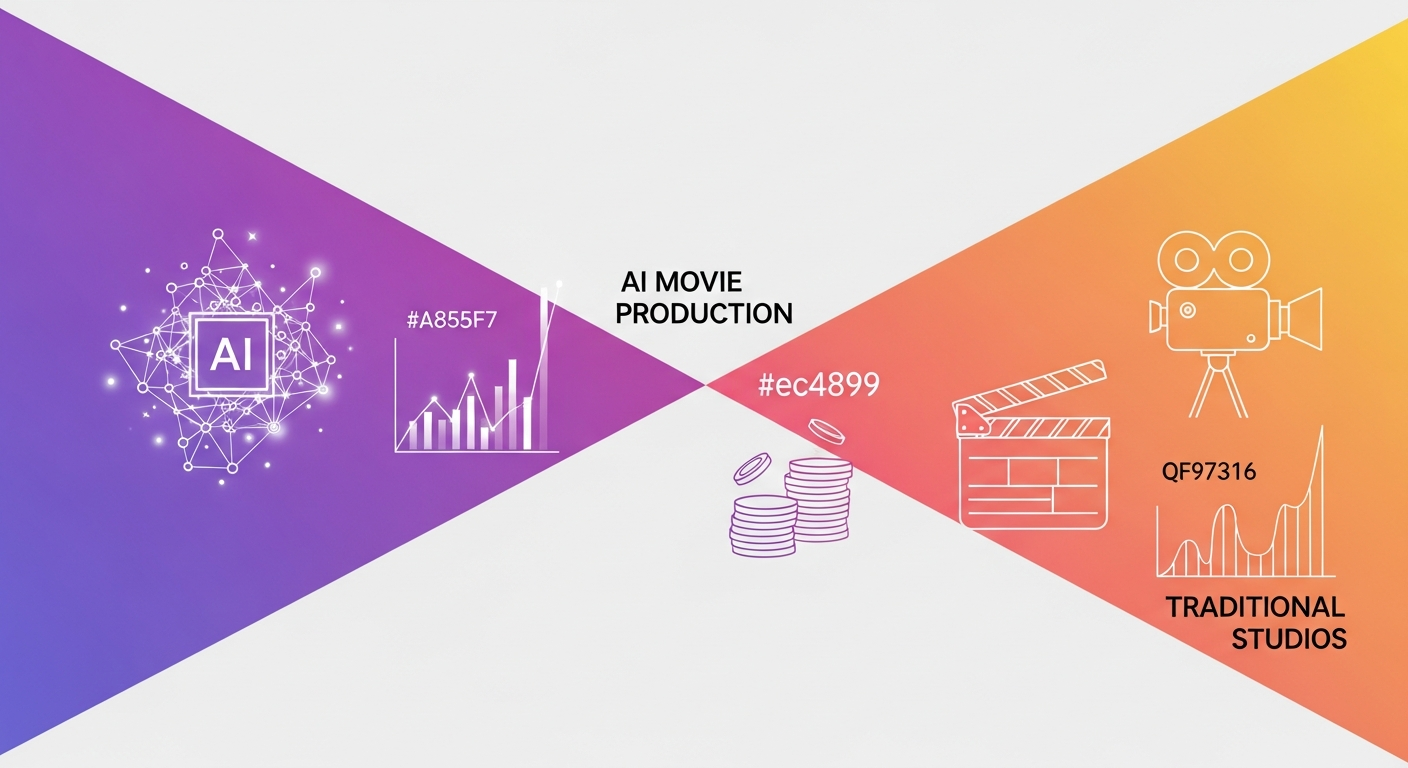
In 2022, blockbuster-level VFX sequences routinely demanded $2M–$5M and teams of 100+ artists. By 2026, AI-driven pipelines—powered by models like OpenAI’s Sora and Runway Gen-3 Alpha—have cut those figures by 60–80% for comparable output. For example, a photorealistic battle scene that cost $2.5M now lands between $500K–$700K with AI-enhanced workflows. These savings aren’t just theoretical; Vidxen clients have banked multi-million-dollar reductions on VFX and post-production alone.
| Sequence Type | Traditional Studio Cost | AI Pipeline Cost | Time (Traditional) | Time (AI) |
|---|---|---|---|---|
| 3-min VFX-heavy scene | $2.5M | $700K | 4 months | 6 weeks |
| Historical doc restoration (60 min) | $300K | $50K | 3 months | 3 weeks |
| Short film (15 min, SFX) | $400K | $120K | 2 months | 3 weeks |
Why such a gap? AI handles rotoscoping, background replacement, upscaling, and even some animation at a fraction of the manual effort. For OTT-ready content and indie films, the economics are even starker: budgets that once shut out visual ambition are now viable.
For a broader look at cost structures across video genres, see AI Video Production Cost in 2026: Full Pricing Guide.
How AI Pipelines Actually Work in Movie Production
Forget the myth that AI “presses a button and makes a film.” Modern AI movie production is a tightly orchestrated workflow—combining tools for generative backgrounds (Google Veo), upscaling (custom neural networks), AI-driven storyboarding, and automated audio mixing. Human directors, DPs, and editors still set the vision. AI handles the repetitive, labour-intensive tasks: frame-by-frame rotoscoping, matte extraction, crowd generation, and clean-up. This hybrid approach means less time lost in tedious post, and more time for creative iteration.
- Script to storyboard: AI tools visualise scenes and camera moves, speeding up pre-production by 3–5×.
- Background and asset generation: Models like Sora and Veo create photorealistic environments, reducing green-screen and on-location costs.
- VFX compositing: Automated masking, inpainting, and object tracking free up artists for final polish.
- Upscaling & restoration: Custom-trained AI delivers pristine 4K from archival or low-res footage.
- Audio & dubbing: AI voices (e.g., ElevenLabs) enable rapid multi-language delivery at ~1/10th the traditional cost.
For a full breakdown of the end-to-end AI workflow, see AI Video Production: The Complete 2026 Guide.
Quality: Can AI Match or Beat Traditional Studios?
In 2024, MIT Technology Review noted that AI-generated video is “virtually indistinguishable from high-end studio output” in controlled settings. That’s true—if you know how to direct the pipeline. AI excels at photorealistic backgrounds, period reconstructions, and rapid iteration. But the best results still come from hybrid teams: AI for speed and scale, humans for creative judgement and nuance.
Weaknesses? AI struggles with complex emotional acting, subtle camera choreography, and unique “director’s vision” shots. For blockbuster drama, you need both. But for action, spectacle, or restoration—AI matches or even surpasses studio quality at a fraction of the cost.
“We delivered a 4K-restored documentary in three weeks—previously a three-month job—without a single artefact, thanks to AI upscaling and scene repair.”
— Vidxen Producer, 2025
For more on AI’s impact on Indian film and TV, see How AI Is Transforming Indian Film & TV in 2026.
What AI Can—and Can’t—Replace in Film Production
Despite industry hype, AI isn’t replacing your director, actors, or on-set crew. What it does: replace endless hours of rotoscoping, set extension, and tedious VFX clean-up. It’s a force-multiplier, not a filmmaker. The most successful productions pair AI tools with experienced creative leads, using tech for what it does best—scale, iteration, and cost control.
- AI excels at: Generative backgrounds, rapid storyboarding, upscaling, crowd simulation, and multi-language dubbing.
- AI falls short at: Directing actors, nuanced performances, unique cinematography, and original story ideation.
Even Variety highlights that leading studios use AI as an enhancer, not a replacement, for creative teams. The workflow is shifting, not vanishing.
Turnaround Times: AI vs. Traditional Studios
Traditional studios typically require 3–6 months for VFX-heavy feature sequences, with post bottlenecked by human capacity. AI-driven workflows compress this to 4–8 weeks—sometimes less for shorter content or documentary work. Revision cycles are faster: AI-generated assets can be tweaked and iterated within days, not weeks, enabling directors to see changes in near-real time.
| Project Type | Traditional Timeline | AI Timeline |
|---|---|---|
| Feature film (120 min, VFX) | 9–12 months | 4–6 months |
| Short film (15 min) | 2–3 months | 3–4 weeks |
| Historical restoration (60 min) | 3 months | 3 weeks |
OTT and streaming platforms now expect faster turnarounds and flexible revision cycles. AI pipelines deliver, making them the new default for time-sensitive projects.
Case Study: $2.5M Saved on VFX with AI-Driven Pipeline
One Vidxen client, an independent studio producing a 90-minute fantasy feature, faced a $3.2M VFX estimate from top-tier traditional vendors. By switching to an AI-enhanced pipeline—leveraging generative backgrounds, automated rotoscoping, and neural upscaling—the final VFX bill landed at $700,000. Delivery time was cut from 16 weeks to 6. Final reviews from the director and streaming platform: “Indistinguishable from leading studio output.”
For a step-by-step breakdown of hybrid workflows, see AI vs Traditional Video Production: 7 Key Differences.
Risks, Pitfalls, and When to Stick with Traditional Studios
AI isn’t a silver bullet. Complex, actor-driven drama or experimental cinema still demands hands-on, traditional artistry. Risks include uncanny visuals, model artefacts, or loss of creative nuance if AI is used blindly. The best productions use AI for what it does best: scale, speed, and technical polish—while keeping human oversight at every decision point.
Industry guidelines from C2PA and major studios stress transparency in AI-generated content, especially for archival restoration or deepfake-style effects. For regulatory and reputational reasons, full disclosure and review are essential.
Bring Your Feature to Life—Blockbuster Quality, Fraction of the Budget
Ready to see how AI-enhanced pipelines can deliver cinematic results and massive cost savings? Brief us on your feature, doc, or short—get a fixed quote and timeline from a producer in 24 hours.
When Should You Choose AI Movie Production?
If you’re producing features, docs, or shorts with heavy VFX, tight timelines, or limited budgets, AI pipelines are now the pragmatic choice. You’ll save 60–80% on post and VFX, hit OTT-grade quality, and iterate faster. For projects driven by performance, improvisation, or highly specific visual language, traditional studios still have the edge. The future is hybrid: use AI for what it does best, and keep humans in the creative seat.
Curious about the hands-on process? Explore the Movie Production service for full pipeline details, use cases, and demo reels.
For marketers and brands, see How to Create AI Marketing Videos: 7-Step 2026 Guide.
For a global market snapshot, see AI Video Production in India: 2026 Industry Report.
FAQ — AI Movie Production vs. Traditional Studios
How much can I actually save using AI movie production?
Industry benchmarks and Vidxen case studies show cost reductions of 60–80% on VFX, restoration, and post-production compared to legacy studio workflows. A sequence costing $2.5M with traditional vendors can often be delivered for $700K or less using an AI pipeline, with no loss in visual fidelity.
Does AI-produced footage really look as good as traditional studio output?
For VFX-driven sequences, backgrounds, and upscaling, yes—if paired with experienced human creative direction. AI-generated video from models like Sora and Veo is now “virtually indistinguishable” from Hollywood output, according to MIT Technology Review. Human oversight is still needed for nuanced drama and unique shots.
What kind of projects benefit most from AI pipelines?
Projects needing rapid VFX, large-scale background generation, archival restoration, or OTT-ready content see the biggest gains. Feature films, documentaries, music videos, and short films with heavy visual effects or tight turnaround requirements are ideal candidates for AI-enhanced workflows.
Can AI replace directors, actors, or creative teams?
No. AI accelerates and enhances visual production, but creative direction, acting, and cinematography remain human-led. The most successful projects use AI for technical tasks and scale, with human creatives ensuring vision and quality.
Are there risks or downsides to using AI in film production?
Yes. Over-reliance on AI can lead to generic visuals, model artefacts, or loss of creative nuance. Regulatory and reputational risks exist if AI-generated content isn’t disclosed transparently. Always pair AI tools with human review and follow guidelines from groups like C2PA.
How fast can AI-driven teams deliver compared to traditional studios?
AI-driven pipelines deliver VFX-heavy sequences in 4–8 weeks, compared to 3–6 months for traditional teams. Short films and documentary restoration can be completed in 3–4 weeks, freeing up time for revisions and creative iteration.
Is AI movie production accepted by OTT platforms and distributors?
Yes. Major OTT and streaming platforms now accept, and in many cases expect, AI-enhanced content—provided quality standards are met. The focus is on final output, not the means of production, as long as legal and ethical guidelines are followed.
Where can I see examples or start a project?
See the Movie Production service page for pipeline breakdowns, demo reels, and a producer contact form. You can brief your project and receive a fixed quote and timeline within 24 hours.