
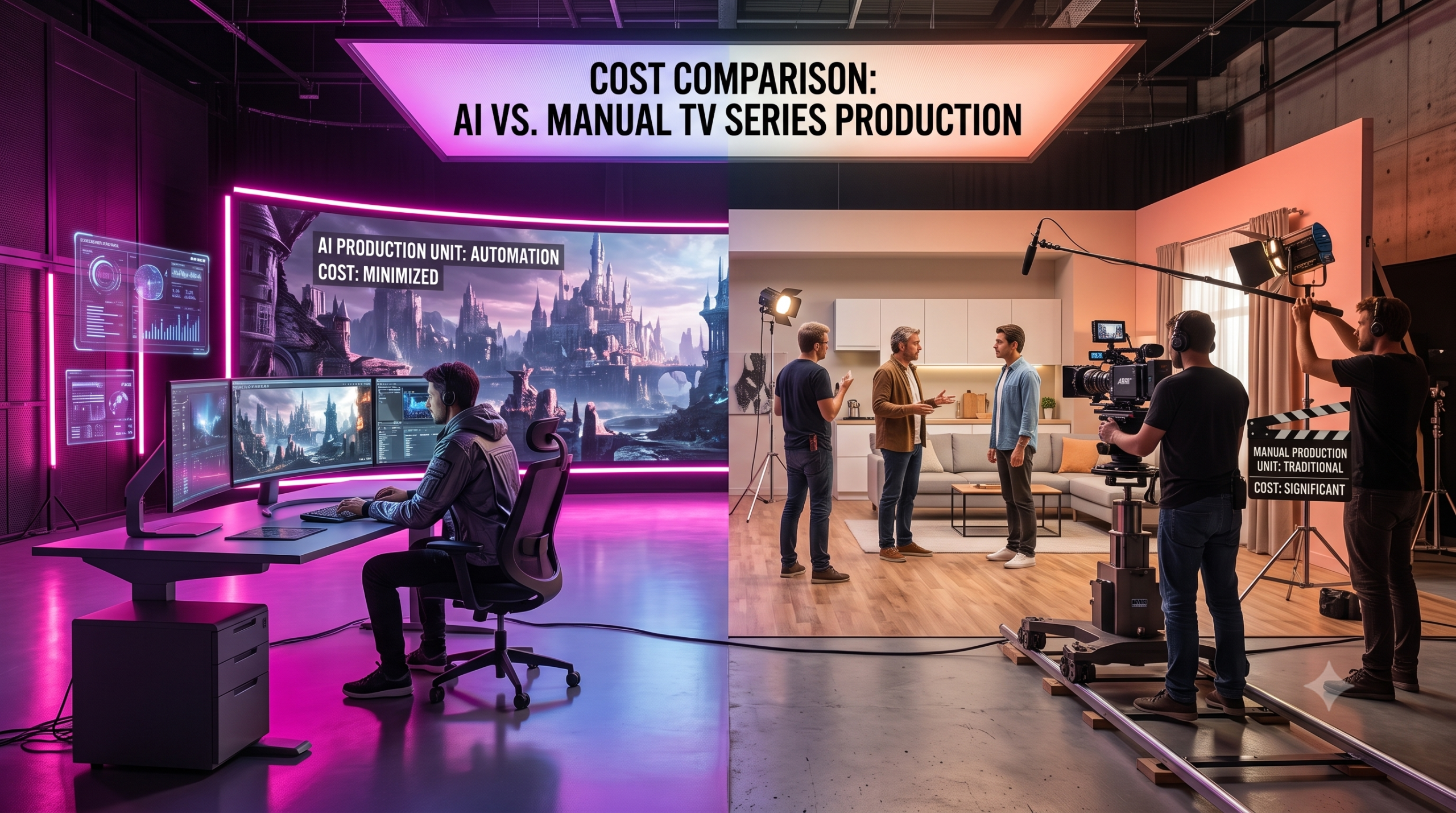
The average hour-long scripted TV episode cost ₹1.8–₹7 crore (≈$250,000–$1M) to produce manually in 2022. Today, episodic AI pipelines routinely cut 30–50% from both budgets and timelines—without sacrificing broadcast quality or creative control.
TL;DR
- AI-driven TV production slashes costs by 30–50% vs manual pipelines.
- Turnaround for a 40-minute episode drops from 5–8 weeks to 2–3 weeks.
- Consistent quality and continuity are easier to maintain at scale with AI-assisted editing and VFX.
- Manual processes still matter for direction and complex creative, but most bottlenecks are now technical, not human.
- Concrete cost tables and real-world examples below—no “AI magic” handwaving.
TV Series Production Costs: The 2024 Baseline
In 2024, a typical 40–60 minute TV episode costs anywhere from ₹1.8 crore (regional drama, basic sets) up to ₹7 crore (OTT premium, VFX-heavy, multi-location shoots) when produced using traditional, manual workflows. This includes scripting, pre-production, principal photography, editing, VFX, dubbing, and delivery for platforms like Netflix or Sony. According to Variety’s industry breakdown, post-production alone can account for 20–35% of total budget—especially with complex editing and multiple language dubs. Manual pipelines are slow and resource-intensive, with 5–8 weeks per episode as a standard timeline, and multi-cam reality shows trending even higher.
Where the Money Goes: Manual vs AI Pipelines
Manual production is a patchwork of separate teams, each with their own timelines and overheads: script supervisors, continuity editors, VFX artists, dubbing studios, localisation teams. AI-powered production pipelines collapse several of these steps, automating repetitive tasks while keeping critical creative decisions with human leads. AI tools like Runway, Google Veo, and OpenAI’s Sora enable rapid scene assembly, real-time VFX, and multi-language dubbing at a fraction of the traditional cost. The result: up to 50% savings on post-production and a 2–4× faster workflow for episodic content.
| Process Step | Manual Cost (₹) | AI-Driven Cost (₹) | Typical Savings |
|---|---|---|---|
| Scriptwriting & Breakdown | 2–6 lakh | 1–2 lakh | 50–70% |
| Editing (per episode) | 8–25 lakh | 3–10 lakh | 50–60% |
| VFX (mid-complexity) | 12–60 lakh | 5–20 lakh | 60–70% |
| Dubbing (multi-language) | 10–35 lakh | 1–4 lakh | ~90% |
| Turnaround (weeks) | 5–8 | 2–3 | 2–4× faster |
For a full season (10 episodes), this can mean a shift from ₹15–35 crore down to ₹8–18 crore for a comparable OTT project—with no drop in broadcast standards.
What AI Actually Changes (and What It Doesn’t)
AI doesn’t replace your showrunner or director. It replaces the tedious, expensive technical bottlenecks: frame-accurate continuity, multi-cam editing, background plate clean-up, and bulk dubbing. For example, ElevenLabs’ AI dubbing can deliver 10+ languages at one-tenth the cost of a traditional studio dub, while tools like Runway Gen-2 automate rotoscoping and background replacement in hours, not days. Script development, casting, and nuanced direction still demand human oversight. The sweet spot: AI handles volume, consistency, and speed; humans drive story, emotion, and creative risk.
Case Study: Episodic AI Pipelines in Action
Consider a 10-episode drama for a major Indian streamer. In 2023, manual post-production averaged 6 weeks per episode, with a total post budget of ₹8 crore. The same project run through an AI-assisted pipeline (automated rough cut, AI VFX, programmatic dubbing, AI quality control) delivered finished episodes in 2.5 weeks, with post costs down to ₹3.2 crore. The network reported improved continuity and fewer late-stage revisions. This isn’t theoretical. The Hollywood Reporter highlights similar shifts in US and Korean markets, where AI pipelines have become standard for high-volume episodic content.
For more on how AI accelerates every stage of content creation, see our Best AI Tools for Streamlining Episodic Content Creation.
Quality and Consistency: The New Non-Negotiables
Audiences expect Netflix-level consistency, whether you’re delivering a regional soap or a pan-India thriller. Manual pipelines struggle with continuity across episodes and seasons—characters’ looks drift, sets change subtly, and VFX integration varies by vendor. AI-driven pipelines enforce pixel-level consistency, using automated QC and reference matching. According to a Google Research study, automated quality checks reduce post errors by up to 80%, slashing expensive late-stage revisions and re-edits. For producers, that’s money and time back on every episode.
When Manual Still Wins: The Limits of AI in TV Production
AI is not a magic wand. Complex action sequences, subtle comedic timing, and high-stakes drama still demand human creative direction and nuanced performance capture. Regulatory and union requirements can also dictate minimum crew sizes or manual review for certain steps. The optimal pipeline is hybrid: AI for volume, speed, and consistency; humans for story, casting, and creative leaps. If you’re producing a prestige drama for global awards, expect to spend at the upper end—AI trims fat, but it doesn’t replace vision.
For a deeper dive into every stage of the new production pipeline, see our AI Video Production: The Complete Guide.
Ready to slash your serial production costs?
Get a transparent, fixed-quote breakdown for your TV or streaming series. See exactly where AI delivers real savings—and where manual craft still matters.
Scaling Up: AI Pipelines and Multi-Episode Production
Manual production hits a wall when scaling from a pilot to a 30-episode season. Footage management, editorial bottlenecks, and VFX render queues balloon costs and timelines. AI pipelines—leveraging episodic templates, auto-tagging, and programmatic scene assembly—allow teams to deliver consistent output at scale. Platforms like Netflix have publicly shared their use of AI for scene matching and QC, enabling them to greenlight and deliver more originals with fewer production overruns. For regional studios, this means competing with global streamers on quality and speed—without tripling your budget.
For more on scaling episodic content, see our Beginner’s Guide to Producing a Web Series.
Hidden Costs and the AI Learning Curve
There’s no free lunch. Adopting AI means upfront investment in pipeline setup, model training (for custom faces/voices), and integration with legacy workflows. Early episodes may require more manual intervention as you dial in reference assets and style guides. But industry estimates from McKinsey suggest break-even is reached within 3–5 episodes for most episodic projects, with compounding savings across a season. The bottom line: AI pays off fastest for high-volume, multi-episode productions—and the learning curve is flattening fast.
How to Decide: AI, Manual, or Hybrid?
If your show demands rapid turnaround, multi-language delivery, or scale (10+ episodes), AI pipelines are now the clear cost winner. For prestige dramas, experimental concepts, or one-off pilots, manual craft still has a role—especially where subtlety or creative risk is essential. Most modern productions blend both: AI for the heavy lifting, human teams for the polish. The real shift is that your bottlenecks are now technical, not human. The question isn’t “AI vs manual”—it’s how to combine both for the best creative and commercial outcome.
For producers ready to modernise their pipeline, see our TV Serials & Series service for a breakdown of solutions, pricing, and outcomes.
For context on choosing the right production partner, see Choosing the Right Studio for TV Serial Production.
FAQ — TV Series Production Cost Comparison
How much does it cost to produce a TV series episode using AI vs manual methods?
Manual production typically costs ₹1.8–₹7 crore per 40–60 minute episode, depending on complexity and platform. AI-assisted pipelines can cut this by 30–50%, with many projects landing in the ₹90 lakh–₹3.5 crore range per episode, especially for multi-episode runs. Savings are highest on editing, VFX, and dubbing.
Is the quality of AI-driven TV production on par with manual workflows?
For most genres, yes. AI pipelines now deliver broadcast-grade output for drama, comedy, and reality series. Automated QC and VFX ensure pixel-level consistency. Manual oversight is still needed for nuanced creative, but technical quality matches or exceeds manual pipelines for the majority of episodic content.
What are the biggest cost savings areas with AI in TV production?
Editing, VFX, and multi-language dubbing. AI automates tedious tasks like rotoscoping, background replacement, and continuity checks, slashing labour costs. Dubbing with AI voices (e.g., ElevenLabs) is 80–90% cheaper than traditional studio dubs. Turnaround times are also cut by half or more, reducing overheads.
Are there hidden costs in adopting AI pipelines?
Initial setup, integration with legacy systems, and model training (for faces, voices, or style) can add upfront costs. There’s also a learning curve for teams. However, these are usually offset within a few episodes, especially for high-volume productions. The break-even point is fast if you’re producing at scale.
Can AI handle all creative aspects of TV series production?
No. AI excels at technical, repetitive, and scalable tasks—editing, VFX, dubbing, and QC. Human oversight is still required for script, direction, casting, and complex creative decisions. The best results come from a hybrid workflow where AI handles volume and consistency, and humans drive story and performance.
How quickly can an AI-driven pipeline deliver a finished episode?
AI pipelines routinely deliver a 40-minute episode in 2–3 weeks, compared to 5–8 weeks for manual methods. This includes editing, VFX, dubbing, and QC. The speed advantage compounds across a season, making it possible to release multi-episode series on tighter schedules.
Which platforms accept AI-produced TV content?
Major streamers (Netflix, Amazon Prime, Hulu, Hotstar) and TV networks increasingly accept AI-assisted content, provided it meets their broadcast standards. Automated QC and delivery in required formats are standard in modern AI pipelines. Always check technical specs and compliance for your target platform.
Where can I see a line-by-line breakdown for my show?
Request a detailed, fixed-quote proposal via our TV Serials & Series service page. You’ll get transparent pricing, workflow recommendations, and a side-by-side comparison of AI vs manual production costs for your specific project.