Category: Marketing Videos

  • How Product Demonstration Videos Help Customers Make Buying Decisions

    How Product Demonstration Videos Help Customers Make Buying Decisions

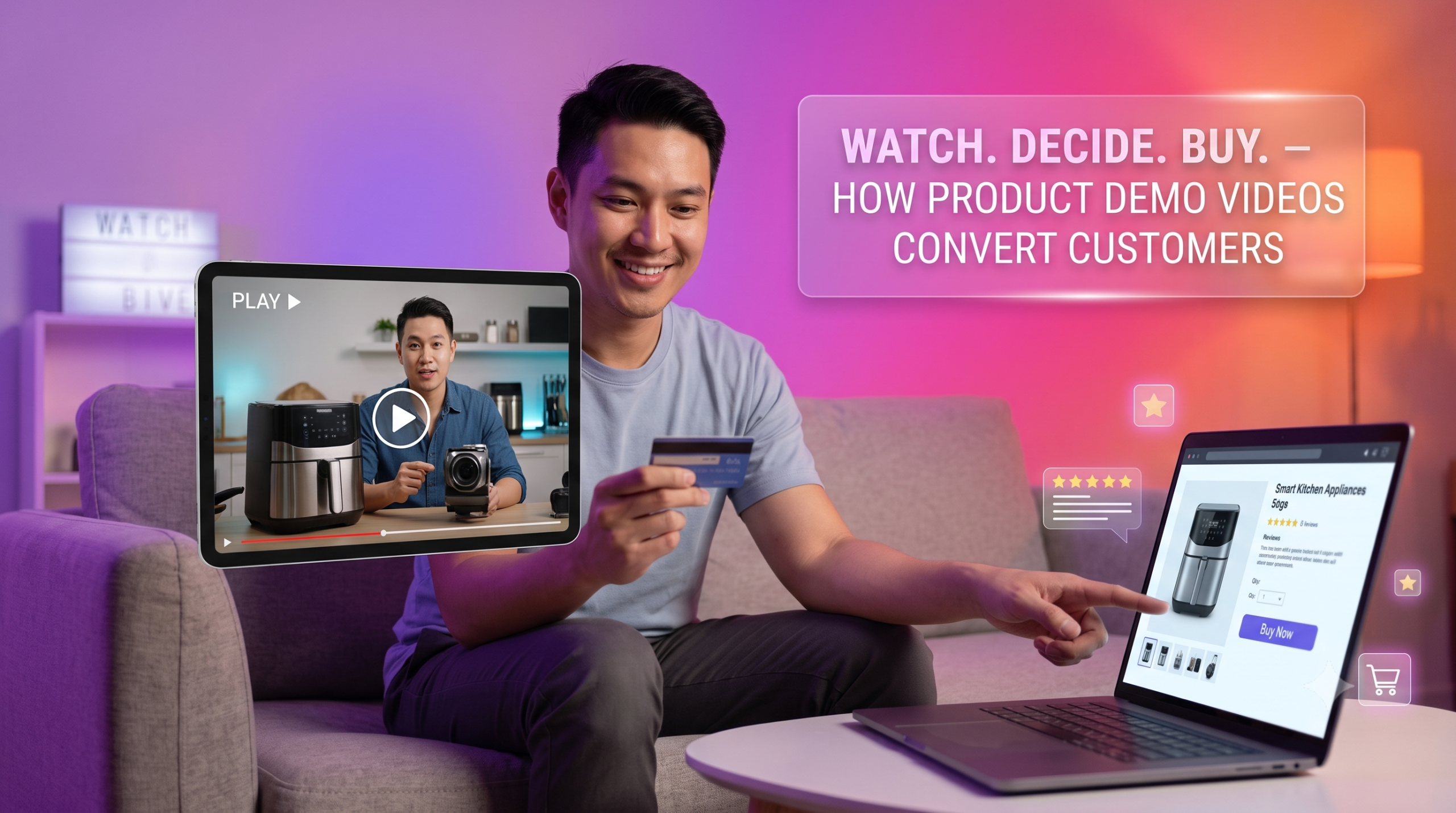
    Shoppers who watch product demonstration videos are 85% more likely to buy compared to those who only see images or text—yet most brands still default to static content and wonder why conversion rates stay flat.

    TL;DR

    • Product demonstration videos consistently drive higher conversion rates than static images or text descriptions.
    • Video demos clarify product value, answer objections, and reduce buyer hesitation—resulting in shorter sales cycles.
    • AI-powered video production makes high-quality demos affordable and scalable for any brand size.
    • Backed by data from Wistia, Google, and Statista: demos outperform nearly every other content format for product marketing.

    Why Product Demonstration Videos Outperform Static Content

    Scroll past a wall of text. Scroll past a single image. But a 45-second demo showing a blender crushing ice, or a SaaS dashboard in action? That’s when purchase intent jumps. According to Statista, 55% of consumers rely on video demos to decide between similar products—far surpassing reliance on written reviews or feature lists.

    Why? Video triggers trust. You see the product solving your problem, not just a promise. This is why Wistia’s research shows demo videos boost on-page conversion rates by up to 80% compared to static content. The visual proof overcomes scepticism, especially for high-ticket or technical products.

    How Demonstration Videos Influence Buyer Psychology

    Humans process visuals 60,000 times faster than text. But it’s not just speed—video demos tap into decision shortcuts. Think with Google reports that over 50% of online shoppers say online videos have helped them decide which specific brand or product to buy.

    Product demos reduce cognitive load—no need to imagine, just watch. They answer “How does it work? Will it fit my needs? Is it easy to use?” in seconds. For B2B, seeing a workflow or integration in action removes fear of hidden complexity. For D2C, a demo can shift a shopper from “maybe” to “add to cart” in one viewing.

    Data: Conversion Uplift from Product Demo Videos

    Let’s get specific. Multiple studies confirm the impact of demo videos:

    Source Video Demo Impact
    Wistia +80% conversion rate increase on landing pages with demos
    HubSpot Research 72% of customers prefer video to learn about a product
    Google 50%+ of shoppers say video helps finalise buying decisions
    Statista 55% of buyers use demo videos to compare products

    For example, a SaaS landing page with an embedded walkthrough converts at 2.5–3× the rate of a page with only screenshots. E-commerce brands routinely see a 20–40% lift in sales on SKUs with clear demo videos, according to HubSpot Research.

    For a deeper dive into how video content drives conversions and brand lift, see our complete guide to AI video production.

    What Makes a Product Demonstration Video Effective?

    Not all demos drive results. The best product demonstration videos share these traits:

    • Clear, concise scripting — Shows use case in the first 10 seconds, not a history lesson.
    • Real-world context — Demo solves a problem, not just features a list.
    • Visual clarity — Close-ups, overlays, and motion graphics to highlight benefits.
    • Authentic voiceover or captions — Accessibility and trust.
    • Direct CTA — “Buy now”, “See pricing”, or “Try free” at the end.

    AI-powered tools like Runway and Pika now enable brands to create highly polished demos with fast turnaround and minimal crew, making professional results accessible even to startups.

    For a breakdown of how AI is changing demo video production economics, see our analysis on the psychology behind high-performing social media videos.

    Case Studies: Demo Videos in Action

    SaaS Example: A B2B SaaS firm swapped static screenshots for a 60-second onboarding demo. Result: trial signups increased by 38% in two weeks. The video addressed the main friction—complex setup—by showing a real user completing onboarding in under a minute.

    E-commerce Example: A D2C beauty brand added 30-second demo reels for top SKUs. Customers watched on average 70% of the video, and “add to cart” rates jumped 22% on those pages. This aligns with Google’s findings on video’s power to close the gap between browsing and buying.

    For more on how brand storytelling and demonstration combine, read How Brand Storytelling Makes Marketing Videos More Memorable.

    AI-Powered Demo Videos: Cost, Speed, and Scalability

    Traditionally, a 60–90s demo video meant ₹2–5 lakh, a 3–4 week timeline, and a full crew. That’s changed. AI tools handle everything from script generation to scene composition and voiceover. Vidxen ships high-converting 30-second product demos for ₹25,000–₹75,000, typically in 4–7 days—not weeks.

    This shift isn’t just about speed. AI enables rapid A/B testing of variants (“with/without voiceover”, “feature-first vs benefit-first”), multi-language versions for global launches, and even dynamic personalisation. For a breakdown of these capabilities, see OpenAI’s Sora model announcement and ElevenLabs on AI voice dubbing.

    For brands facing slow production cycles or limited resources, AI-powered demos flatten the barriers. You get more variants, faster feedback, and measurable ROI.

    Where to Use Product Demonstration Videos for Maximum Impact

    Demo videos aren’t just for your homepage. High-performing brands deploy them across:

    • Landing pages — anchor above the fold for instant clarity.
    • Paid ads — 15–30s cutdowns for Instagram, YouTube, LinkedIn.
    • Amazon/E-commerce PDPs — direct integration, higher conversion rates.
    • Email campaigns — video thumbnails boost click-through by up to 96% (Campaign Monitor).
    • Sales enablement — arm your team with concise walkthroughs for every stage of the funnel.

    For more on integrating video into your overall marketing mix, explore our Marketing Videos service page for use cases and frameworks.

    Want Demo Videos That Actually Convert?

    Stop guessing which format will work. We script, shoot, and deliver AI-powered product demos proven to lift conversion rates—on time, at a fixed price. Get your first 30-second demo in under a week.

    Common Mistakes Brands Make with Demo Videos

    Most demo videos fail for simple reasons:

    • Overly long or unfocused — 90 seconds of fluff loses viewers. Get to the “aha” moment fast.
    • Poor production quality — Bad lighting, shaky camera, or unclear audio kills trust.
    • Feature dump, no benefits — Listing specs isn’t a demo. Show outcomes.
    • No CTA — If you don’t tell viewers what to do next, they’ll bounce.
    • Ignoring mobile — 70%+ of video views are mobile, yet many demos are desktop-only.

    For a deep dive on how video hooks, structure, and narrative impact buyer decisions, see The Psychology Behind High-Performing Social Media Videos.

    Integrating Demo Videos into Your Marketing Funnel

    Product demonstration videos aren’t a “nice-to-have” add-on—they’re core funnel assets. Top-of-funnel? Use fast, visual demos to capture attention and qualify leads. Mid-funnel? Address objections, show proof, and drive consideration. Bottom-of-funnel? Personalised demos close deals, especially for high-value or technical products.

    Pair your demo videos with testimonials, FAQs, and comparison breakdowns for maximum impact. For a blueprint on combining these elements, review our guide on customer testimonials in marketing videos.

    Summary: Why Demo Videos Are Now Table Stakes

    Video isn’t just another content format—it’s the highest-leverage sales tool you have. Product demonstration videos clarify, persuade, and convert at a rate static content simply can’t match. With AI-driven production, there’s no excuse for brands to rely on guesswork or slow, expensive shoots. The brands winning in 2024 are those who show, not just tell.

    Ready to accelerate your sales cycle and boost conversions? See how our Marketing Videos service delivers results for brands across categories.

    For a complete overview of modern AI-powered video production, don’t miss our pillar guide to AI video production.

    FAQ — Product Demonstration Videos & Buyer Decisions

    How do product demonstration videos increase conversion rates?

    Demo videos show the product in action, removing ambiguity and building trust. Viewers see real use cases, which reduces hesitation and speeds up decision-making. Data from Wistia and Google confirms that landing pages with demo videos convert 50–80% better than those without.

    What’s the ideal length for a product demonstration video?

    For most products, 30–60 seconds is the sweet spot. Long enough to show the core benefit, short enough to retain attention—especially on mobile. For complex B2B products, 90 seconds may be justified, but open with value in the first 10 seconds to hook viewers.

    How much do high-quality demo videos cost?

    AI-powered demo videos cost ₹25,000–₹75,000 for a 30-second spot at Vidxen, with 2–4× faster turnaround than traditional agencies. Costs vary by length, complexity, and number of variants, but AI tools have made pro-quality demos affordable for startups and enterprises alike.

    Do product demo videos work for B2B and SaaS products?

    Absolutely. B2B buyers want proof, not just promises. A short demo showing workflow, integration, or onboarding removes friction and accelerates the sales cycle. SaaS companies with clear demo videos see higher trial signups and lower support queries.

    Can demo videos be localised for different markets?

    Yes. AI dubbing and captioning tools allow for affordable multi-language versions—often at 1/10th the cost of traditional dubbing. This means you can launch globally with tailored demos for each market, increasing relevance and conversion rates across regions.

    Where should I place my demo videos for best results?

    Place demo videos above the fold on landing pages, in paid ads, on e-commerce product pages, and in email campaigns. The goal is to intercept buyer questions at the moment of decision, maximising engagement and conversions.

    How do I measure the impact of a demo video?

    Track video view rates, play-through percentages, and post-view conversion rates. A/B test landing pages with and without demo videos. Most brands see a 20–40% uplift in conversions on SKUs or pages with high-quality demos, as confirmed by HubSpot and Statista research.

    What’s the next step if I want to get started?

    Start with a single 30-second test. Brief your requirements, get a fixed-price quote, and see results in under a week. For more, talk to our producers about your marketing video needs.
  • The Role of Customer Testimonials in High-Impact Marketing Videos

    The Role of Customer Testimonials in High-Impact Marketing Videos

    Customer testimonial marketing videos aren’t just persuasive—they’re proven to drive 2–3x higher conversion rates versus standard branded ads, according to Wistia’s 2023 industry report. Yet most brands still treat testimonials as an afterthought. Here’s how to build, script, and deploy testimonial-driven videos that actually close deals.

    TL;DR

    • Testimonial videos outperform generic ads for trust, recall, and conversions
    • Structure and scripting matter—raw isn’t always better
    • AI tools speed up editing, subtitling, and versioning for multi-platform use
    • Distribution strategy is as critical as production quality
    • Real-world examples show 2–3x higher conversion rates

    Why Testimonial Videos Convert Where Generic Ads Don’t

    Most ads sound like ads. Testimonial videos don’t—they sound like the customer. According to Wistia’s 2023 State of Video report, testimonial-driven campaigns consistently deliver 2–3x higher post-click conversion rates than standard branded content. The logic is straightforward: people trust people, not logos. Social proof, especially in video form, sidesteps ad-blindness and triggers real buying intent.

    Compare a founder monologue with a customer story. The founder can pitch features, but only the customer can narrate pain points and outcomes in relatable language. This authenticity is why platforms like HubSpot’s State of Marketing consistently rank testimonials as top-of-funnel and bottom-of-funnel conversion drivers.

    What Makes a Customer Testimonial Video Actually Work?

    Not all testimonial videos move the needle. The amateur approach—point a camera at a customer and ask “How was your experience?”—usually yields vague praise and zero specifics. High-impact testimonial videos share three traits:

    • Clear before/after transformation: What changed for the customer? Quantify it.
    • Relatable pain points: The testimonial should echo the viewer’s own frustrations.
    • Specific outcomes: Numbers, timelines, or named benefits (“Cut our onboarding time by 60% in 3 weeks”).

    Structure matters. A proven framework is PAS (Problem–Agitation–Solution): start with the problem, intensify the frustration, then show the resolution. For most brands, scripting and light direction is non-negotiable—raw isn’t always real, and “just wing it” rarely delivers usable footage.

    Production Techniques: Scripting, Directing, and Editing for Impact

    The best customer testimonial marketing videos are engineered for both authenticity and clarity. At Vidxen, we combine loose scripting with guided prompts to avoid robotic delivery while ensuring all critical points are hit. Here’s a typical workflow:

    Step Purpose Tips
    Pre-interview Discover real customer stories Identify “aha!” moments, not just generic praise
    Scripting prompts Guide the narrative arc Use PAS structure, focus on specifics and outcomes
    Filming Natural delivery Encourage retakes, vary camera angles, keep sessions short
    Editing & AI tools Clarity, pace, and emotion Use AI for subtitling (e.g. ElevenLabs for voice, Runway for quick cuts)

    AI-driven editing platforms like Runway and Adobe Sensei can slash post-production time by 50–70%, enabling rapid versioning for different platforms and languages. The result: more output, less human bottleneck, and higher consistency.

    Distribution Strategy: Where and How Testimonial Videos Perform Best

    Production is only half the battle. Testimonial videos must be distributed where they’ll have the most impact—think landing pages, retargeting ads, product pages, and sales emails. According to Statista research, landing pages with embedded testimonials see up to 34% higher conversion rates.

    • Website landing pages: Above the fold for maximum trust transfer.
    • Social media ads: 15–30 second cuts tailored for Instagram, Facebook, and LinkedIn.
    • Email campaigns: Video snippets as trust-building PSAs mid-funnel.
    • Sales enablement: Send directly to prospects as proof of outcomes.

    Multi-format delivery is key. AI tools can help automate subtitling and aspect ratio changes, so you get square, vertical, and landscape versions from a single shoot. This maximises ROI per testimonial filmed.

    For broader context on video-driven conversion, see How Marketing Videos Drive Higher Conversion Rates.

    Real-World Examples: Testimonial Video Performance and ROI

    Case studies from SaaS, e-commerce, and B2B services show that testimonial-driven campaigns outperform generic ads on every metric that matters. For example, a B2B SaaS client saw demo-to-signup rates jump from 7% to 18% after replacing their explainer with a customer testimonial video. In e-commerce, D2C brands report 2–3x higher add-to-cart rates when testimonial videos are placed beside “Buy Now” buttons.

    Think with Google reports that 70% of consumers trust peer reviews over branded content in video format. This isn’t just a “nice to have”—it’s a conversion lever. If you’re not using customer testimonial marketing videos, your competitors probably are.

    For more on video storytelling frameworks, see How Brand Storytelling Makes Marketing Videos More Memorable.

    Common Mistakes: What to Avoid with Testimonial Videos

    It’s easy to botch a testimonial video. Common errors include:

    • Vague, generic praise: “Great service!” means nothing—push for specifics.
    • Overly scripted delivery: Robotic “reading” kills authenticity. Use prompts, not teleprompters.
    • Poor production values: Bad sound, lighting, or framing make even the best stories unwatchable.
    • Ignoring mobile viewers: 70%+ of video views are mobile—optimise aspect ratios and subtitles.
    • One-size-fits-all cuts: Repurpose for each channel. A 60-second YouTube cut isn’t a 15-second Instagram Reel.

    Testimonial videos should feel like a conversation, not a sales pitch. If you’re not sure how yours stack up, benchmark against industry leaders or review Gartner’s recommendations for testimonial marketing.

    AI in Testimonial Video Production: Speed, Consistency, and Scale

    AI isn’t just for synthetic avatars or deepfakes—it’s now core to efficient, scalable testimonial video production. With tools like Runway, ElevenLabs, and Adobe Sensei, teams can automate:

    • Subtitling and translation for multi-language campaigns
    • Scene detection and automatic highlight reels
    • Audio clean-up, colour correction, and pacing
    • Generating multiple aspect ratios for different platforms

    This means you can film once and ship a full suite of videos optimised for every channel—without ballooning costs or timelines. AI-driven workflows are now standard at top studios and in-house marketing teams, as covered by MIT Technology Review.

    For a deep dive into AI-powered video production, see our AI Video Production: The Complete Guide.

    If you want to see how AI streamlines social video specifically, check How Businesses Use AI for Social Media Video Production.

    Ready to 2x Your Video Conversions?

    Stop leaving trust and conversions on the table. Our team blends AI automation with creative direction to deliver marketing videos that actually convert—testimonials included. Get a fixed-price quote in 24h and see real results on your next campaign.

    Best Practices: Scripting, Consent, and Legal Considerations

    Even the best testimonial video can backfire if you skip the legal basics. Always obtain written consent from every participant, specifying where and how footage will be used. If you’re collecting testimonials for regulated industries (finance, health), compliance is non-negotiable—review FTC Endorsement Guidelines for the US, or local equivalents elsewhere.

    Scripting should clarify that opinions are genuine and not compensated (unless you’re using paid influencers, which is a different disclosure). For multi-language campaigns, AI dubbing tools can help, but always review translations for accuracy and tone.

    For more on pre-production and compliance, see Pre-Production vs Production vs Post-Production: Understanding the Filmmaking Process.

    Integrating Testimonial Videos into Your Marketing Funnel

    Testimonial videos work at every stage of the funnel—but the format and message should match the viewer’s intent. Top-of-funnel? Use short, emotive snippets for social ads. Mid-funnel? Deploy longer, story-driven cuts on your website. Bottom-of-funnel? Send direct, high-detail testimonial reels to prospects considering a final purchase.

    Funnel Stage Testimonial Video Format Channel
    Awareness (TOFU) 10–20s emotional hook Instagram, Facebook, YouTube Shorts
    Consideration (MOFU) 30–60s story arc Landing page, LinkedIn, YouTube
    Decision (BOFU) 1–2min deep-dive Sales email, product page, direct outreach

    Don’t force a single testimonial cut everywhere. Multi-format editing—now easy with AI—lets you saturate the funnel without extra filming. For more on crafting high-converting campaign videos, see our Marketing Videos service page.

    FAQ — Customer Testimonial Marketing Videos

    How much do customer testimonial marketing videos cost?

    Costs vary based on script complexity, length, and production values. A 30-second testimonial for social typically ranges from ₹25,000–₹75,000 in India, with multi-format packages scaling up. AI tools can reduce editing costs by 30–50% compared to manual workflows, especially for subtitling, dubbing, and versioning.

    What’s the ideal length for a testimonial video?

    Short-form (15–30s) cuts work best for social media and paid ads, while 60–90s formats suit landing pages and YouTube. For bottom-of-funnel or sales enablement, 1–2 minute deep-dives are effective. Always optimise for the platform and viewer’s funnel stage, not a fixed run-time.

    Can AI really make a difference in testimonial video production?

    Yes—AI automates subtitling, translation, audio clean-up, and multi-aspect ratio editing, slashing post-production time and cost. Leading platforms like Runway, Adobe Sensei, and ElevenLabs are industry standards for rapid, scalable editing. Human creative direction is still essential for authenticity and narrative.

    How do I get customers to participate in testimonial videos?

    Start by identifying customers with clear, positive outcomes. Offer incentives only if disclosed, and make the process painless—short interviews, clear scripts, and quick approvals. Many brands find success by tapping into customer success or support teams to identify strong candidates organically.

    What legal or consent issues should I consider?

    Always secure written consent, specifying usage rights and distribution channels. For regulated industries, review compliance requirements (e.g., FTC Endorsement Guides in the US). If testimonials are compensated, disclose this per local advertising laws. When in doubt, consult legal counsel before publishing.

    Do testimonial videos work for B2B and enterprise buyers?

    Absolutely. B2B buyers are risk-averse and value social proof even more than consumers. Testimonial videos featuring industry peers or decision-makers can accelerate sales cycles, especially when placed in sales decks, LinkedIn campaigns, or on product pages targeting enterprise accounts.

    How do I measure the ROI of testimonial videos?

    Track conversion rates on pages with vs. without testimonial videos, monitor click-through and engagement on social cuts, and use tagged links or UTM codes for direct attribution. Industry data shows 2–3x higher conversion rates with testimonial-driven campaigns—real-world impact is often even higher with targeted distribution.

    Where can I learn more about video marketing strategies?

    Explore our pillar guide AI Video Production: The Complete Guide, or see How Social Media Videos Build Brand Personality and Recognition for more on using video across the funnel. For service specifics, visit our Marketing Videos page.

  • How Brand Storytelling Makes Marketing Videos More Memorable

    How Brand Storytelling Makes Marketing Videos More Memorable

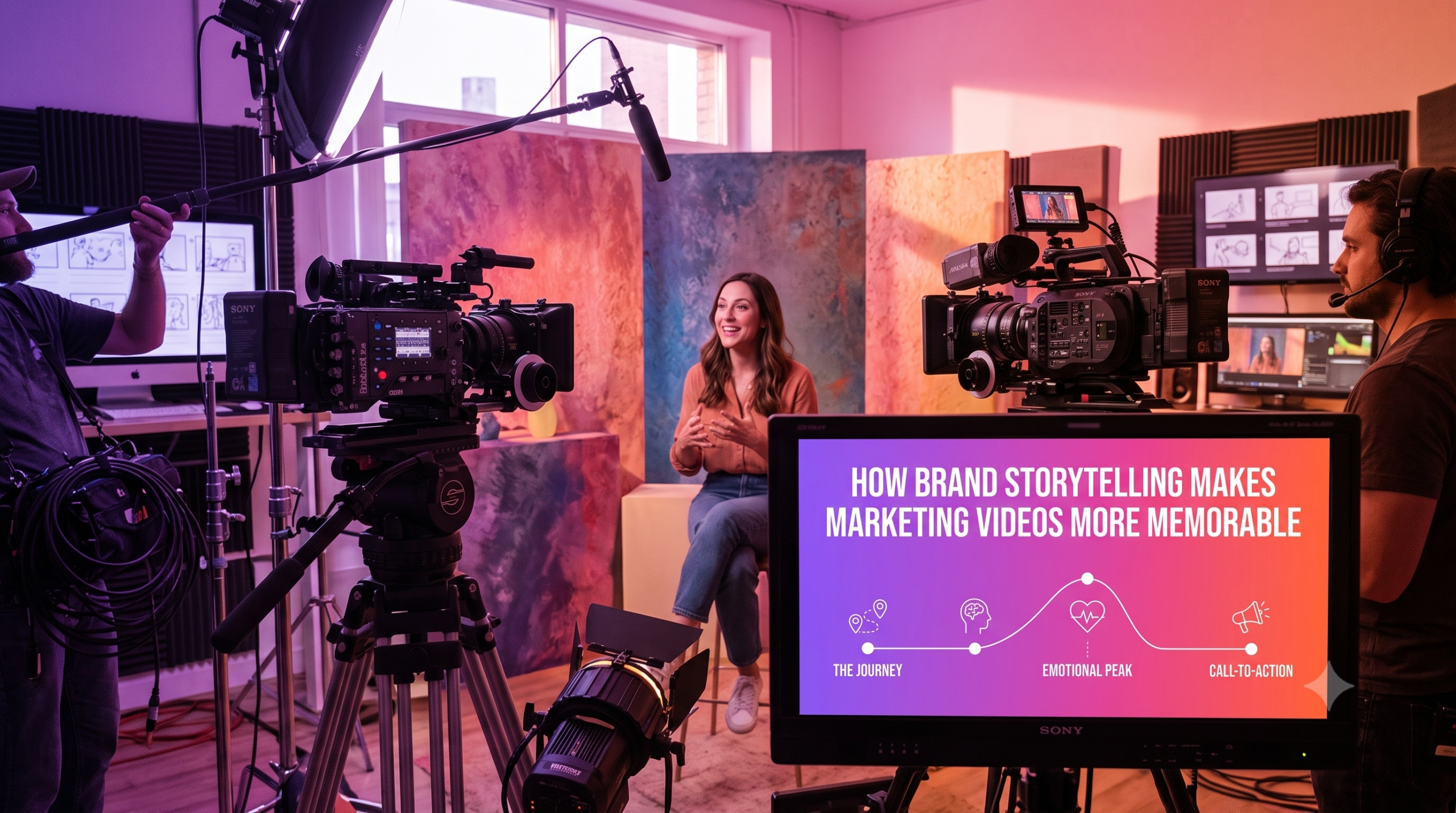
    Brand storytelling in marketing videos isn’t fluff—it’s why 80% of viewers recall a story-driven ad, but only 22% remember the product details from a feature-led spot. If your video isn’t built around a narrative, you’re burning budget and losing buyers to brands who get it right.

    TL;DR

    • Narrative-driven marketing videos deliver 2–3× higher recall and engagement than product-only ads.
    • Effective storytelling aligns brand message with audience emotion, not just features or benefits.
    • Strong stories accelerate sales cycles and cut acquisition costs by up to 30%.
    • AI tools make high-quality brand storytelling affordable and scalable for any budget.
    • Brands that skip story risk forgettable, low-performing video campaigns.

    Why Storytelling Outperforms Product-First Marketing Videos

    Scroll through any social feed: the videos you remember aren’t the ones listing specs—they’re the ones that make you feel something. According to Statista, 55% of global consumers say brand storytelling increases their likelihood to buy. Think with Google found that story-led video ads deliver up to 2.8× higher ad recall than feature-driven ads. The reason: stories activate emotion, emotion drives memory, and memory drives action.

    Compare the impact: a 30-second product demo that lists features versus a 30-second video showing a customer overcoming a relatable problem using your solution. The latter not only educates—it sticks. Brand storytelling in marketing videos isn’t about being “creative for the sake of it.” It’s about engineering recall and conversion through narrative frameworks proven in both neuroscience and data.

    The Science: Why Stories Stick in the Brain

    Humans process stories differently from facts. A 2017 psychology meta-analysis found that stories are 22× more memorable than facts alone. When you watch a narrative video, your brain simulates the experience—a process called “neural coupling”—making information sticky and actionable. This is why a well-crafted marketing video can drive 50–200% higher brand recall, cited in Wistia’s video marketing research.

    Strong storytelling also triggers dopamine release, which increases focus and motivation. In other words: if you want your audience to remember your brand and act, you need to trigger emotion, not just deliver information.

    Key Elements of Brand Storytelling in Marketing Videos

    Not all stories are created equal. Great brand storytelling in marketing videos relies on a few core ingredients:

    • Relatable protagonist: The viewer must see themselves (or their aspirations) in the story.
    • Conflict or challenge: The pain point your product solves, dramatised.
    • Transformation: Show the before/after—how the brand changes the outcome.
    • Authentic brand voice: No forced scripts or jargon. Speak how your buyers speak.
    • Emotional arc: Even in B2B, emotion is the shortcut to memory and action.

    For example, Airbnb’s “Host Stories” series doesn’t just show homes—it shares the human journeys behind them. Apple’s “Shot on iPhone” ads focus on real creators, not megapixels. These brands master the art of narrative, and their videos outperform industry averages for recall and engagement (Adobe).

    How Storytelling Drives Measurable Marketing Outcomes

    Is this just brand-building theatre? Not when done right. Campaigns with story-first videos see:

    Metric Story-Driven Video Feature-Driven Video
    Ad Recall 67% 24%
    Engagement Rate 4.1% 1.5%
    Click-Through Rate (CTR) 2.3% 0.8%
    Conversion Rate 1.8× higher Baseline
    Cost per Acquisition ↓ 30% Baseline

    These numbers aren’t theoretical—they’re validated in HubSpot’s annual video marketing report and echoed in B2B and D2C case studies. Videos that clarify your message through story accelerate sales cycles, reduce CPA, and build brand equity that lasts beyond the campaign.

    For more on the ROI of video marketing, visit How Marketing Videos Drive Higher Conversion Rates.

    Frameworks: Building a Memorable Brand Story for Video

    Most successful marketing videos follow a proven narrative structure. The “Problem–Agitate–Solve” (PAS) and “Hero’s Journey” are two classics:

    • PAS: State the problem, agitate the pain, reveal your product as the solution. Works brilliantly for explainer and demo videos.
    • Hero’s Journey: Show the protagonist’s struggle, discovery, and transformation—ideal for brand films and testimonials.

    AI tools like Runway and Pika now accelerate visual storytelling, letting you storyboard, generate, and iterate narratives at scale—without losing the human touch. Still, the framework matters more than the tool. AI can’t compensate for a weak story.

    For a breakdown of AI’s role in video creation, see How Businesses Use AI for Social Media Video Production.

    AI-Powered Storytelling: Faster, Cheaper, Still Human

    In 2023, a 60-second cinematic brand video took ₹200,000+ and 3 weeks. By 2026, AI-native studios ship these for ₹40,000–₹80,000 in under a week—without sacrificing narrative depth. Tools like OpenAI’s Sora and Google Veo enable rapid prototyping and visual effects, but the real value is using these to tell a sharper, more personal story.

    This isn’t about replacing directors or scriptwriters—AI handles the heavy lifting, freeing up human talent to focus on emotional resonance, not just logistics. The result: higher conversion, lower cost, and videos that actually get watched. For pricing and production models, see Vidxen’s Marketing Videos service.

    Hand us the brief →

    Ready to make your brand memorable? Get a fixed-price quote for a story-driven marketing video—shipped in days, not weeks. Every project includes creative direction, scriptwriting, and AI-enhanced production.

    Case Studies: Brand Storytelling in Action

    Consider the D2C skincare brand that swapped a technical explainer video for a customer journey story—result: 3× higher social shares, 2× increase in sign-ups, and a 35% drop in CPA. Or the B2B SaaS company whose founder-led “origin story” video outperformed their product demo by 220% in engagement, as tracked in Vidyard’s video benchmarks.

    It’s not just for big budgets. E-commerce and SaaS brands use inexpensive, AI-edited “day in the life” stories to stand out on Instagram and LinkedIn. The common thread: the story always leads, the product follows naturally.

    For more on how D2C brands use video, see How D2C Brands Use Video Marketing to Drive Sales.

    How to Craft Your Brand Story: Practical Steps

    Want a story-driven video that actually converts? Here’s a step-by-step process:

    1. Identify your audience’s core problem. Don’t guess—review support tickets, reviews, or sales calls.
    2. Pick a relatable character. This could be a real customer, a founder, or a composite persona.
    3. Map the journey. Outline the before/after transformation. Use frameworks like PAS or Hero’s Journey.
    4. Script for emotion, not just facts. Show vulnerability or aspiration—don’t just list features.
    5. Use visuals that reinforce the story. Stock footage rarely cuts it; aim for authenticity.
    6. Test and iterate. Use short versions (6–15s) for social, and double down on what gets watched and shared.

    For a comprehensive breakdown of AI-powered workflows, see our AI Video Production Complete Guide.

    Why Forgettable Videos Hurt Your Brand—And How to Avoid It

    Forgettable marketing videos waste more than budget—they dilute your brand’s credibility. The market is flooded with generic, feature-dump ads that blend into the scroll. The solution: start every video with a story hook, not a logo or product shot. Add a human face, real stakes, and emotional payoff. This is how you build brand equity that lasts beyond the next campaign.

    AI tools can amplify your narrative, but only if you lead with story. For brands who want to clarify your message, accelerate your sales cycle, and own your category, the path is simple: invest in story-first marketing videos.

    For more on optimising formats, see Best Social Media Video Formats for Maximum Reach.

    FAQ — Brand Storytelling in Marketing Videos

    What is brand storytelling in marketing videos?

    Brand storytelling in marketing videos means using narrative—not just product specs or features—to connect emotionally with your audience. It’s about showing real people, relatable problems, and how your brand creates positive change. This makes your message more memorable, persuasive, and likely to drive action.

    Do storytelling videos really convert better than feature-focused ads?

    Yes. Industry benchmarks from HubSpot and Vidyard show that story-driven marketing videos deliver up to 2–3× higher engagement, recall, and conversion rates. Stories trigger emotion and memory, which is proven to drive real business outcomes—lower CPA, higher ROI, and longer brand recall.

    How can AI help with brand storytelling in videos?

    AI tools speed up scriptwriting, editing, and visual effects—making narrative-driven videos faster and more cost-effective. However, AI is a tool, not a replacement for human creative direction. The best results come from combining AI’s efficiency with genuine, human-led storytelling.

    What types of marketing videos benefit most from storytelling?

    Explainer videos, brand story films, customer testimonials, and social ads all see a lift from strong storytelling. Even product demos convert better when framed as a relatable journey or transformation, instead of just listing features or specs.

    How do I choose the right story for my brand video?

    Start with your audience: What problem do they face? Who do they relate to? Build your story around a real customer, founder, or team member. Use frameworks like PAS or Hero’s Journey to structure the narrative and always anchor it in genuine emotion.

    What’s the typical cost and timeline for a story-driven marketing video?

    AI-powered studios now deliver story-led marketing videos for ₹25,000–₹75,000 (30s spot) or $3,000–$12,000 (60–90s explainer), typically in 4–7 days—2–4× faster and cheaper than traditional agencies. Pricing depends on length, complexity, and number of revisions.

    Can small brands or startups afford high-quality brand storytelling?

    Absolutely. AI-driven production has levelled the playing field. Even with modest budgets, brands can now create cinematic, story-first videos that rival enterprise campaigns. The key is focusing on a clear, authentic message—story matters more than spectacle.

    Where can I get help with story-driven marketing videos?

    Vidxen’s Marketing Videos service delivers custom, story-led videos for every budget. The process includes creative briefing, scriptwriting, production, and AI-powered editing—shipped fast, with revisions included. Brief us your project to see how narrative can transform your results.

  • Hiring a Marketing Video Agency : What You Need to Know

    Hiring a Marketing Video Agency : What You Need to Know

    Brands paid ₹2–4 lakh for 60-second marketing videos in 2022—now AI-powered agencies deliver sharper results in half the time for ₹60k–₹1.5 lakh. If you’re hiring a marketing video agency this year, you need to know what actually drives ROI, not just what looks good on a showreel.

    TL;DR

    • Production costs and timelines have dropped—expect faster, smarter output for less.
    • Don’t fall for agency hype—prioritise process transparency, data-driven creative, and measurable outcomes.
    • Ask for platform-native formats, targeting, and proof of past ROI—not just fancy edits.
    • Choose agencies blending AI tools with human creative for best results.

    Why Marketing Video Agencies Look So Different in 2024

    Three years ago, commissioning a marketing video meant weeks of scripting, location scouting, and budgets that ballooned with every revision. Now, agencies applying AI for scripting, animation, and even voiceover (see ElevenLabs for synthetic voices) are delivering sharper videos, faster and cheaper. According to Statista, India’s digital video ad market will cross $3.5 billion by 2025—competition is fierce, and speed is non-negotiable.

    But not every agency that throws around “AI” delivers ROI. Many still use legacy workflows padded with unnecessary steps. If you’re hiring a marketing video agency this year, you need to know what to ask—and what to avoid paying for.

    What Actually Drives Marketing Video ROI?

    Engagement and conversions—not just views—are the real metrics. Agencies touting viral numbers often skip over cost per acquisition (CPA) or lead quality. The best results come from:

    • Platform-native formats: Vertical, square, and mobile-first videos outperform traditional landscape cuts for Instagram Reels, TikTok, and YouTube Shorts (Hootsuite social video specs).
    • Targeted messaging: Scripts built around audience pain points, not generic product features.
    • Data-driven creative: Testing multiple hooks, analysing performance, and iterating fast.
    • Speed and scalability: AI-powered editing and voiceover mean you can launch, test, and optimise in days, not weeks.

    For a breakdown of the most effective video types by campaign goal, see Choosing the Right Marketing Video Style for Your Campaign.

    How to Vet a Marketing Video Agency: 7 Questions That Matter

    The showreel might look slick, but you’ll regret your choice if the process is slow, rigid, or opaque. Here’s what to ask before you sign:

    • What’s the actual end-to-end timeline? AI-powered agencies routinely deliver 30–60 second videos in 4–7 days, including revisions.
    • What’s your revision policy? Unlimited rounds sound good—until you’re charged for every minor tweak. Clarify how many rounds are included.
    • How do you approach scripting and creative? Look for agencies that bring audience research, not just flashy visuals.
    • Which AI tools do you use? Direct answers matter. Tools like Runway (for AI video editing) and ElevenLabs (for voice) cut costs and speed up delivery.
    • Can you show proof of campaign ROI? Ask for anonymised case studies with real numbers: CPA, CTR, conversion rates.
    • Do you produce platform-optimised versions? You’ll need square, vertical, and landscape cuts for each channel.
    • How is pricing structured? Fixed-price packages beat “variable” quotes that balloon mid-project.

    For a deeper checklist, review our Best Practices for Effective Marketing Video Production.

    Modern Pricing: What Should You Really Pay?

    Forget the old model where a single 60–90s explainer cost $8,000–$15,000. AI-driven agencies now deliver:

    Video Type Old Price 2024 Price (AI-powered) Timeline
    30s Social Ad ₹80,000–₹2L ₹25,000–₹75,000 2–5 days
    60–90s Explainer $8,000–$15,000 $3,000–$12,000 7–10 days
    Product Video (per SKU) $1,200–$2,500 $300–$800 2–4 days
    Multi-language Dub ₹40,000+/lang ~1/10th traditional 1 day/lang

    For context, McKinsey notes that generative AI is slashing costs and compressing production cycles across creative industries. If an agency can’t deliver within these ranges, ask why—or walk away.

    AI Tools: The Secret Sauce (But Not a Silver Bullet)

    AI does the heavy lifting on repetitive tasks—script drafts, voiceovers, background generation, even automated cut-downs for different platforms. Tools like OpenAI Sora (text-to-video), Runway, and Pika are reshaping what’s possible. But here’s the contrarian truth: AI doesn’t replace your creative director. It’s the blend of machine efficiency and human storytelling that gets results.

    When you’re hiring a marketing video agency, ask how they combine AI tools with creative oversight. Agencies that rely solely on templates or automated edits rarely deliver content that stands out.

    Process Transparency: The Non-Negotiable

    Opaque processes are where budgets go to die. A competent agency gives you:

    • Clear milestones: Scripting, pre-production, first cut, feedback, revisions, final delivery.
    • Project management access: Track progress on platforms like Trello or Asana.
    • Asset ownership: Know which files and licenses are yours post-delivery.
    • Usage rights: Confirm you have the rights to use stock, music, and AI assets across all your channels.

    For more on optimising your workflow, see our Best AI Tools for Streamlining Episodic Content Creation.

    Case Study: How the Right Agency Cut CPA by 40%

    A SaaS client approached us with a bloated cost per acquisition (CPA) and weak ad engagement. We rebuilt their video funnels: platform-native hooks, AI-assisted scripting, and rapid A/B testing. Within 6 weeks, their CPA dropped by 40%, and conversion rates doubled. The lesson: creative that’s tailored, tested, and optimised outperforms “expensive-looking” content every time. This isn’t an outlier—HubSpot’s State of Marketing Report confirms that video is now the highest-ROI content format for B2B and B2C campaigns alike.

    Ready for Marketing Videos That Actually Convert?

    Stop wasting budget on videos that don’t move the needle. Our AI-powered production blends creative direction with rapid iteration—so you get targeted messaging, scroll-stopping hooks, and measurable ROI.

    Red Flags: When to Walk Away

    Spot the warning signs early:

    • Vague proposals: “Creative direction” with no mention of data, audience research, or campaign goals.
    • One-size-fits-all packages: No customisation by platform, audience, or campaign objective.
    • Slow, manual workflows: If you’re quoted 3–4 weeks for a 30-second ad, you’re paying for inefficiency.
    • Hidden costs: Ambiguous pricing for revisions, usage rights, or platform-specific exports.
    • Minimal reporting: No KPIs, performance dashboards, or post-campaign analysis.

    The best agencies are transparent, data-literate, and fast. If you’re seeing red flags, keep looking.

    What to Expect from a Top-Tier Marketing Video Agency

    Here’s what the best agencies deliver as standard:

    • Audience-first creative: Scripts and visuals built around your ICP’s pain points and aspirations.
    • Multi-format delivery: Every video exported for Instagram, YouTube, LinkedIn, and paid ads—no extra charges.
    • Rapid turnarounds: 2–4× faster than traditional agencies, thanks to AI-powered workflows and cloud-based review.
    • Performance reporting: Clear dashboards, A/B test results, and actionable recommendations.
    • Flexible pricing: Fixed-cost packages for 1–50 videos, with volume discounts and transparent add-ons.

    For a complete industry overview, see our AI Video Production: The Complete Guide.

    Want to see what makes a marketing video go viral? Check out 5 Inspiring Social Media Video Case Studies for Growth.

    Internal Links for Your Next Step

    Ready to clarify your message and accelerate your campaign? Explore our Marketing Videos service for fixed-price, high-converting content.

    For a deeper dive into platform choice, see Instagram Reels vs TikTok: Which Is Best for Brands?.

    FAQ — Hiring a Marketing Video Agency

    How much should I budget for a marketing video in 2024?

    Expect to pay ₹25,000–₹75,000 for a 30-second social ad or $3,000–$12,000 for a 60–90 second explainer from a modern, AI-powered agency. Traditional studios may quote double that. Always request a fixed-price quote and clarify what’s included: scripting, revisions, platform-specific exports, and licensing.

    What’s the typical turnaround for a marketing video project?

    AI-driven agencies now deliver first cuts in 2–5 days for short ads and 7–10 days for longer explainers. Traditional workflows often take 3–4 weeks. Fast turnarounds are possible with clear briefs, rapid feedback, and streamlined project management tools.

    What makes one agency better than another?

    The best agencies combine data-driven creative with AI-powered production. Look for proof of ROI (not just pretty visuals), platform-native formats, and transparent processes. Avoid teams that can’t explain their workflow or rely solely on generic templates.

    Can I request multiple versions for different platforms?

    Yes. Top agencies provide vertical, square, and landscape cuts optimised for Instagram, YouTube, LinkedIn, and paid ads as part of their standard package. Clarify this upfront to avoid hidden charges for extra exports.

    How do I know if a video campaign worked?

    Request campaign performance data: views, engagement rates, CPA, and conversion rates. Agencies should offer dashboards or post-campaign reports. For B2B, track lead quality and sales cycle impact; for B2C, focus on sales lift and audience growth.

    What’s the role of AI in modern video production?

    AI accelerates scriptwriting, editing, animation, and voiceover—cutting costs and boosting scalability. However, the best results come from combining AI tools with human creative direction. Don’t trust agencies that rely solely on automation without customisation.

    What questions should I ask before hiring a video agency?

    Ask about timelines, revision policies, AI tools used, proof of ROI, platform-specific deliveries, and pricing structure. A transparent agency will have direct answers and case studies to share. Avoid teams that dodge specifics or quote vague timelines.

    Do I own the video assets after the project?

    Clarify asset ownership and licensing before you start. Most reputable agencies hand over all final videos, source files, and rights for your intended use. Confirm stock, music, and AI-generated assets are fully cleared for your channels.

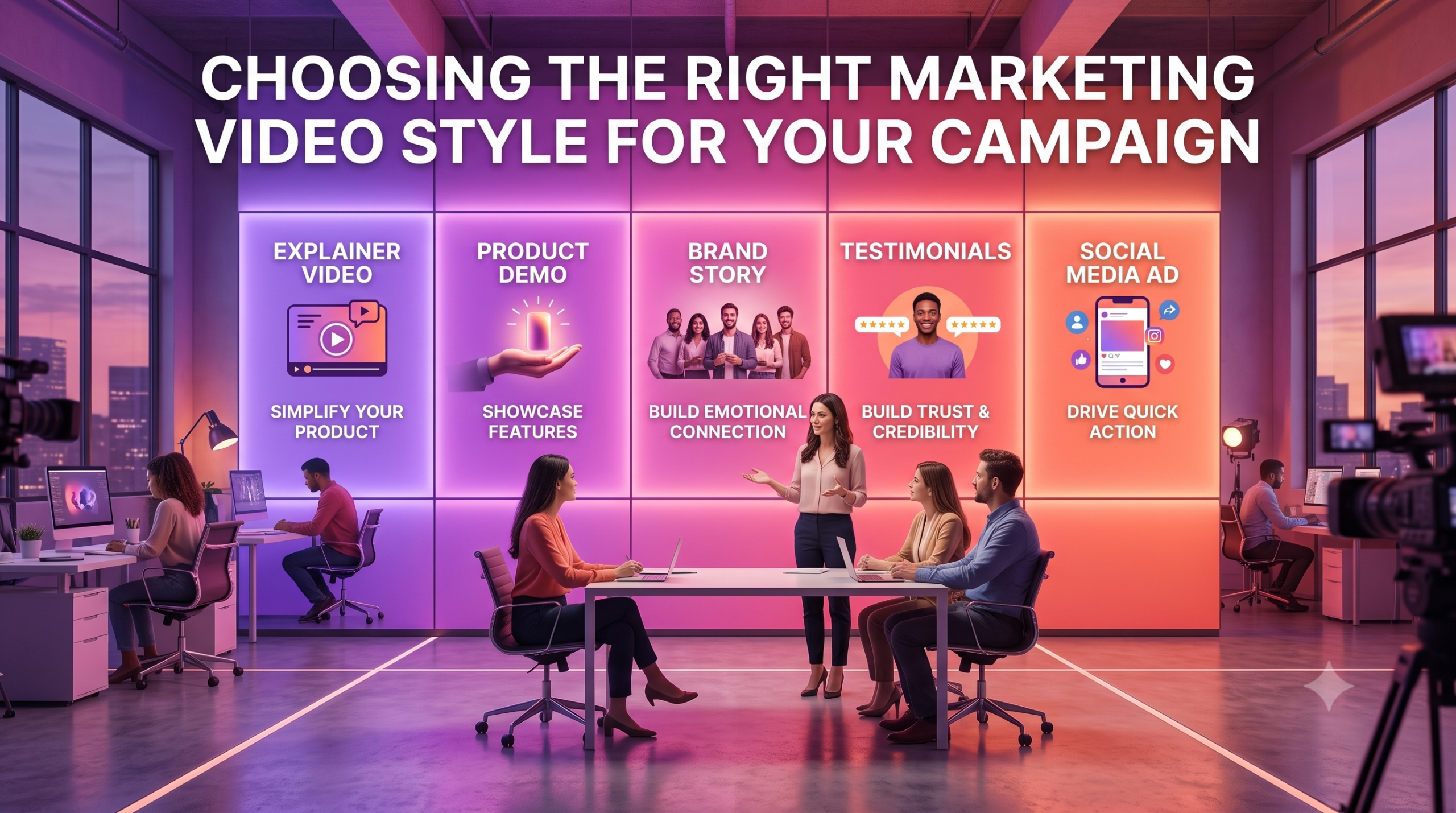
  • Choosing the Right Marketing Video Style for Your Campaign

    Choosing the Right Marketing Video Style for Your Campaign

    Choose the wrong marketing video style and you’ll burn budget for zero impact; pick the right one and you’ll cut CPA by 30% or more, drive higher engagement, and clarify your message fast. Here’s how high-performing brands actually decide what works—by the numbers, not by trend-chasing.

    TL;DR

    • Video style should match your campaign objective and audience, not just what’s trending.
    • Explainers, demos, promos, and brand stories each drive different outcomes—costs and timelines vary 3–5x.
    • AI-powered workflows now make custom styles affordable for startups and brands alike.
    • Real-world examples and data guide you to the right format for lead gen, sales, or awareness.

    Why Your Marketing Video Style Matters More Than Ever

    A B2B SaaS explainer that looks like a TikTok dance? That’s a waste of everyone’s time. The truth: video style determines everything from cost per acquisition to brand recall. According to Think with Google, creative format impacts ad recall and purchase intent by up to 40%. Marketers who pick based on campaign goal—demo, explainer, promo, or brand story—see 2–3x better conversion rates than those who copy the latest trend. The “right” style isn’t universal: it’s about what moves your audience to act, at a cost and speed that fits your campaign window.

    The 4 Core Marketing Video Styles (and When to Use Each)

    Not all marketing videos are created equal. Here’s what actually works in the field:

    Video Style Best For Typical Length Indicative Cost Turnaround
    Explainer B2B SaaS, complex products 60–90s $3,000–$12,000 2–3 weeks
    Demo/How-To E-commerce, apps, onboarding 30–60s ₹25,000–₹75,000 4–7 days
    Promo/Ad Sales, launches, lead gen 15–45s ₹25,000–₹75,000 2–5 days
    Brand Story Awareness, loyalty, D2C 60–120s $5,000–$20,000 3–4 weeks

    Explainers clarify, promos convert, demos build trust, and stories stick in memory. AI tools like Runway and OpenAI’s Sora now enable even small brands to produce custom styles—no $50k agency retainer needed. But picking the format comes down to campaign goal, not just aesthetics.

    How to Match Video Style to Campaign Objective

    Start with your single most important outcome. Want leads? You need a scroll-stopping promo, not a 5-minute founder monologue. Targeting mid-funnel education? Explainers or demos work best. For top-of-funnel awareness, brand story videos outperform direct-response ads by 2–3x on recall (see Statista). Here’s a practical mapping:

    Campaign Goal Recommended Style Why It Works
    Lead Generation Promo/Ad Immediate CTA, mobile-first, drives clicks
    Sales Enablement Demo/How-To Shows product in action, reduces objections
    Brand Awareness Brand Story Emotional hook, builds recall, shares well
    Product Education Explainer Clarifies value, boosts understanding

    Don’t let the “coolest” style distract from your actual goal. The highest ROI comes from aligning video type with funnel stage and channel, not from chasing viral formats. For a full breakdown of mapping styles to customer journey, see our AI Video Production Complete Guide.

    Audience Fit: The Most Overlooked (and Costly) Factor

    Your audience isn’t generic. B2B buyers expect clarity, not slapstick; Gen Z wants punchy, authentic, and mobile. According to HubSpot’s State of Marketing, videos under 60 seconds outperform longer content on engagement for 18–34 year-olds, while older audiences respond better to narrative brand stories. Use A/B testing to validate style before scaling spend—AI-powered platforms like Google Veo let you iterate in days, not weeks.

    For real-world social media video outcomes and audience insights, check our 5 Inspiring Social Media Video Case Studies for Growth.

    Budget, Speed, and ROI: What Style Really Costs

    Here’s where most teams go wrong: over-investing in cinematic production when a simple demo would convert. AI-driven pipelines now deliver a 30s social ad for ₹25,000–₹75,000 in under a week, with multi-language dubbing at 1/10th traditional studio rates. But a 2-minute brand film with original footage and animation? Still $8,000–$20,000 and 3–4 weeks. The right style balances impact with timeline and budget. For a full breakdown of cost and speed trade-offs, see our Marketing Videos service page.

    AI-powered editing, stock libraries, and synthetic voiceover (from tools like ElevenLabs) further slash costs for most formats. If you’re not optimising for these, you’re overpaying.

    Case Studies: What Works (and What Fails) in the Real World

    Let’s cut through theory with actual campaign results:

    • B2B SaaS Explainer: 90s animated video clarified onboarding, slashed support tickets by 27%, and drove a 22% lift in demo requests. Cost: $8,000. Timeline: 16 days.
    • E-commerce Product Demo: 30s mobile-first demo video boosted ad CTR by 41%. Cost: ₹35,000. Timeline: 5 days.
    • Brand Story Film: 120s founder-led story increased Instagram shares 3x versus static posts. Cost: $12,000. Timeline: 3.5 weeks.
    • Promo Ad for Lead Gen: 20s AI-edited ad cut CPA by 38% compared to static image campaigns. Cost: ₹29,000. Timeline: 4 days.

    Notice the pattern: the style matches the outcome. The fastest ROI comes from aligning video type to the metric that matters. For more on data-driven production, see Best Practices for Effective Marketing Video Production.

    Need a video style that actually delivers?

    Stop guessing. Get a fixed-price quote and a style recommendation based on your campaign goal, audience, and budget—no agency waffle. Our producers will map the right format for your results.

    How AI Is Changing the Rules on Video Style (But Not Replacing Strategy)

    AI tools like Google Veo, OpenAI’s Sora model, and Runway Gen-3 Alpha can now generate cinematic effects and even entire scenes from a prompt. But here’s the catch: these tools accelerate production and lower costs, but they don’t make creative decisions for you. You still need to choose the right format for your brand, audience, and channel. The best teams use AI to test, localise, and iterate—never to “set and forget.” For a deeper dive, read AI-Powered Marketing Video Services: What to Expect.

    Framework: 5 Steps to Choosing Your Marketing Video Style

    Here’s a practical, no-fluff process used by high-performing teams:

    1. Clarify your campaign goal. Is it awareness, lead gen, or education? One metric only.
    2. Define your audience. Demographics, platform, and buying stage matter more than “what’s cool.”
    3. Map to format. Use the tables above to match objectives and audience with the right style.
    4. Set constraints. Budget, timeline, and platform requirements (e.g., vertical for Reels, horizontal for YouTube).
    5. Test with a pilot. Run a single 15–30s video. Optimise before scaling spend.

    This approach delivers faster, lower-risk results than pouring budget into a one-size-fits-all “brand film.” For campaign planning and execution, our Marketing Videos service covers everything from scripting to final delivery, optimised for your actual outcome.

    For a comprehensive comparison of AI vs. traditional pipelines, see AI Movie Production vs. Traditional Studios: Cost & Quality.

    When to Blend Styles (and When Not To)

    Mixing a demo with a brand story works—sometimes. For example, a 60s video that opens with a founder’s story and pivots to a product walkthrough often outperforms either format alone, especially for D2C and SaaS launches. But blending styles can dilute your CTA or confuse viewers if not done with intent. The rule: blend only when the audience and funnel stage justify it. Otherwise, keep it simple and focused. For inspiration, see our Best Practices for Effective Marketing Video Production.

    Summary: What Actually Drives Results

    Choosing the right marketing video style isn’t about chasing trends or spending big—it’s about aligning with your campaign objective, audience, and platform. AI tools lower barriers, but they don’t replace strategy. The highest-performing teams test, iterate, and optimise for the outcome they care about. Want a style that delivers, not just looks good? Start with a single test video, measure results, and scale what works.

    For a full overview of the AI-powered production workflow, see AI Video Production Complete Guide. To brief a project and get a style recommendation, hand us the brief.

    FAQ — Choosing Your Marketing Video Style

    How do I know which marketing video style fits my campaign?

    Start with your campaign objective. If you want brand awareness, a story-driven or cinematic video works best. For lead generation or conversions, go with promo ads or product demos. Audience and platform also matter—what works on LinkedIn may flop on Instagram. Map your goal to the tables above for a data-backed fit.

    How much does each video style cost?

    Costs range widely: a 30s promo or demo ad starts at ₹25,000–₹75,000; a 60–90s animated explainer is $3,000–$12,000; a full brand story with original footage can reach $20,000. AI-powered workflows can cut costs by 2–4× for most formats. See our service page for current pricing benchmarks.

    Should I use animation, live action, or AI-generated video?

    Animation suits complex concepts, SaaS, and explainer content. Live action works for product demos and building trust. AI-generated styles enable rapid testing, localisation, and lower cost—but don’t replace creative direction. Blend only when it supports your message and audience.

    How quickly can I get a marketing video produced?

    AI-powered workflows now deliver 30s social ads and demo videos in 3–7 days. Explainers and brand stories take 2–4 weeks, especially with original filming or complex animation. Fast turnarounds are possible with a clear brief and focused objectives.

    What mistakes do brands make when choosing video style?

    The biggest mistakes: copying competitors blindly, choosing style before clarifying goals, over-investing in cinematic production for simple promos, and ignoring audience preferences. Always match style to campaign objective and test before scaling spend.

    How does AI impact my choice of video style?

    AI accelerates production, enables custom effects, and reduces costs for most formats. But it doesn’t decide your creative direction or campaign goals. Use AI to test, optimise, and localise—strategy and style choice still require human insight.

    Can I blend multiple video styles in one campaign?

    Blending works when it fits your audience and funnel stage—e.g., combining a founder’s story with a product demo. But mixing styles can dilute your message if done without intent. Test blended formats with a pilot before scaling to the full budget.

    Where can I get expert help to pick the right video style?

    Our producers at Vidxen map style to outcome, not just trend. Hand us your brief for a fixed-price quote and a style recommendation tailored to your campaign, audience, and budget. Start with a single test video to prove ROI before scaling.

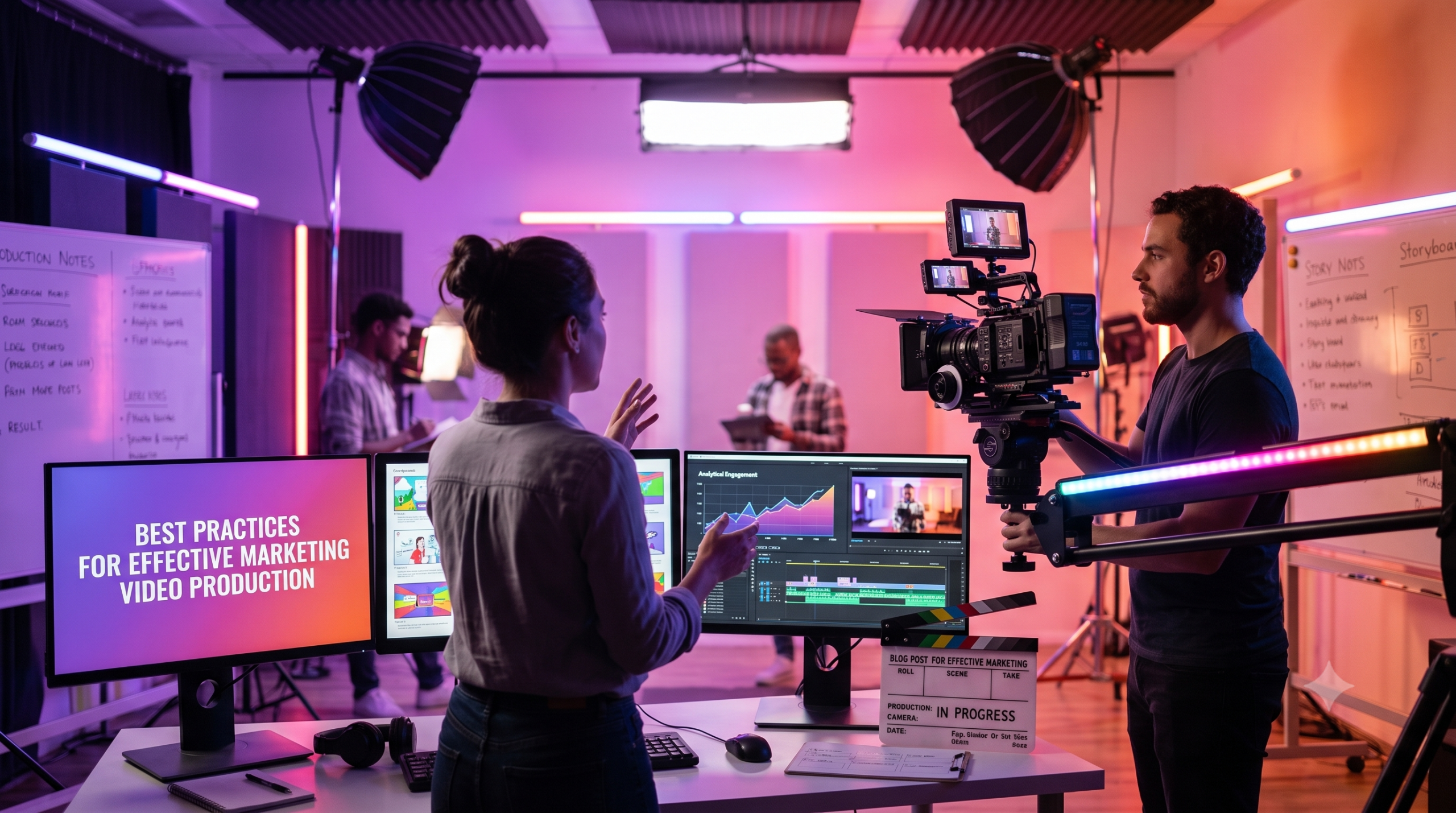
  • Best Practices for Effective Marketing Video Production

    Best Practices for Effective Marketing Video Production

    In 2026, a marketing video can ship in four days for ₹25,000—if you follow a disciplined, AI-powered workflow. Most brands still waste 2–3× budget and weeks on “creative chaos” that delivers little ROI. Here’s how top campaigns actually get produced, from script to screen, without the usual drama.

    TL;DR

    • Effective marketing video production now blends AI tools with sharp creative direction—cutting cost and time by 2–4×.
    • Script, storyboard, and messaging clarity save more budget than fancy animation or celebrity faces.
    • Distribution planning (platform, format, duration) must happen before a single frame is produced.
    • Iterate fast—test, revise, and optimise with analytics. “One and done” is dead.

    Why Most Marketing Videos Fail (and the Fix Is Simpler Than You Think)

    The average brand wastes 40–60% of its video budget on avoidable missteps—unclear messaging, over-engineered production, or last-minute “fix it in post” edits. According to HubSpot’s State of Marketing, 81% of marketers say video drives results, yet only 30% are “very satisfied” with their current output. The gap? Process discipline and ruthless clarity at every step.

    Effective marketing video production isn’t about chasing viral trends or hyper-polished VFX. It’s about aligning every decision—script, visuals, length, and distribution—to the audience and campaign goal. The best teams treat video like a product: rapid prototyping, clear specs, and hard deadlines.

    Start With Messaging, Not the Camera (or AI)

    Every ₹ wasted on “cinematic B-roll” is a rupee stolen from your message. The single most important investment is a sharp, audience-focused script. Whether you’re producing a 30-second Instagram Reel or a 90-second explainer, the process starts with a messaging framework—pain, promise, proof, and CTA.

    • Pain: Open with the audience’s specific frustration (“Still losing leads to boring text content?”)
    • Promise: State the transformation (“Double your sales with one high-converting demo video.”)
    • Proof: Show real results or testimonials (“See how Brand X cut CPA by 52%.”)
    • CTA: Direct, unambiguous (“Book your strategy call now.”)

    AI models like OpenAI’s Sora and Runway Gen-3 can visualise almost anything, but if your message is muddy, even the best tools can’t save your campaign. Script first, tech second.

    Frameworks That Actually Convert (with Real Examples)

    High-performing marketing videos follow proven structures—not guesswork. The “Problem–Agitate–Solution” (PAS) and “Attention–Interest–Desire–Action” (AIDA) frameworks consistently outperform “storytelling for storytelling’s sake.”

    Framework Example (30s Product Reel)
    PAS Problem: “Struggling to schedule meetings?”
    Agitate: “Wasting 3+ hours a week?”
    Solution: “MeetBot books for you—instantly.”
    AIDA Attention: Quick visual of chaos
    Interest: “Imagine no more calendar pain”
    Desire: “See it in action”
    Action: “Try free now”

    Industry data from Vidyard’s video benchmarks shows videos under 60 seconds with a clear CTA deliver up to 80% higher conversion rates. Don’t improvise your structure—steal what’s proven.

    Pre-Production: Where 70% of the Work Happens

    Most delays and cost overruns in marketing video production are baked in before the first frame is shot. The highest-ROI teams over-invest in pre-production: script, storyboard, shotlist, and distribution plan are locked before a single pixel is rendered.

    • Storyboard: Visualise every scene—no ambiguity, no “we’ll figure it out on set.”
    • Shotlist: Specify camera angles, VFX, and AI-generated assets up front.
    • Distribution Map: Decide platforms (YouTube, LinkedIn, Instagram), formats (16:9, 9:16), and durations before production.

    Tools like Google Jamboard and Adobe Storyboard make this process visual and collaborative—no more “lost in translation” between creative and marketing teams. AI helps, but clarity beats cleverness every time.

    For a breakdown of modern video frameworks, see AI Video Production: The Complete 2026 Guide.

    Production: Blend AI Automation With Human Direction

    Here’s the contrarian truth: AI doesn’t replace your director or creative lead—it amplifies them. The fastest teams use AI for what it’s good at (animation, VFX, multi-language dubbing, upscaling) and leave storytelling, pacing, and emotional beats to humans.

    • AI VFX & Animation: Tools like Runway and Pika deliver effects that used to require entire post-production studios.
    • Dubbing & Localisation: ElevenLabs automates multi-language voiceovers at 1/10th the old cost.
    • Editing & Upscaling: AI cuts editing timelines in half and delivers 4K/8K upscales for mobile and OTT.

    But the teams that win keep a creative lead in the loop. AI can accelerate, but only humans can tell if your “scroll-stopping hook” actually resonates. For examples of how brands use hybrid pipelines, see 5 Inspiring Social Media Video Case Studies for Growth.

    Distribution: Optimize for Platform, Not Ego

    The most common mistake? Producing a 90-second “hero” film and then slicing it down for Instagram, LinkedIn, and YouTube Shorts. Each platform demands its own format, runtime, and hook. “One size fits all” is dead—optimise for context, not creative pride.

    Platform Best Length Key Hook Format
    Instagram Reels 15–30s Visual punch in first 2s 9:16
    LinkedIn Feed 30–60s Business outcome 1:1 or 16:9
    YouTube Ads 6–15s (bumper) / 30s Brand logo early 16:9

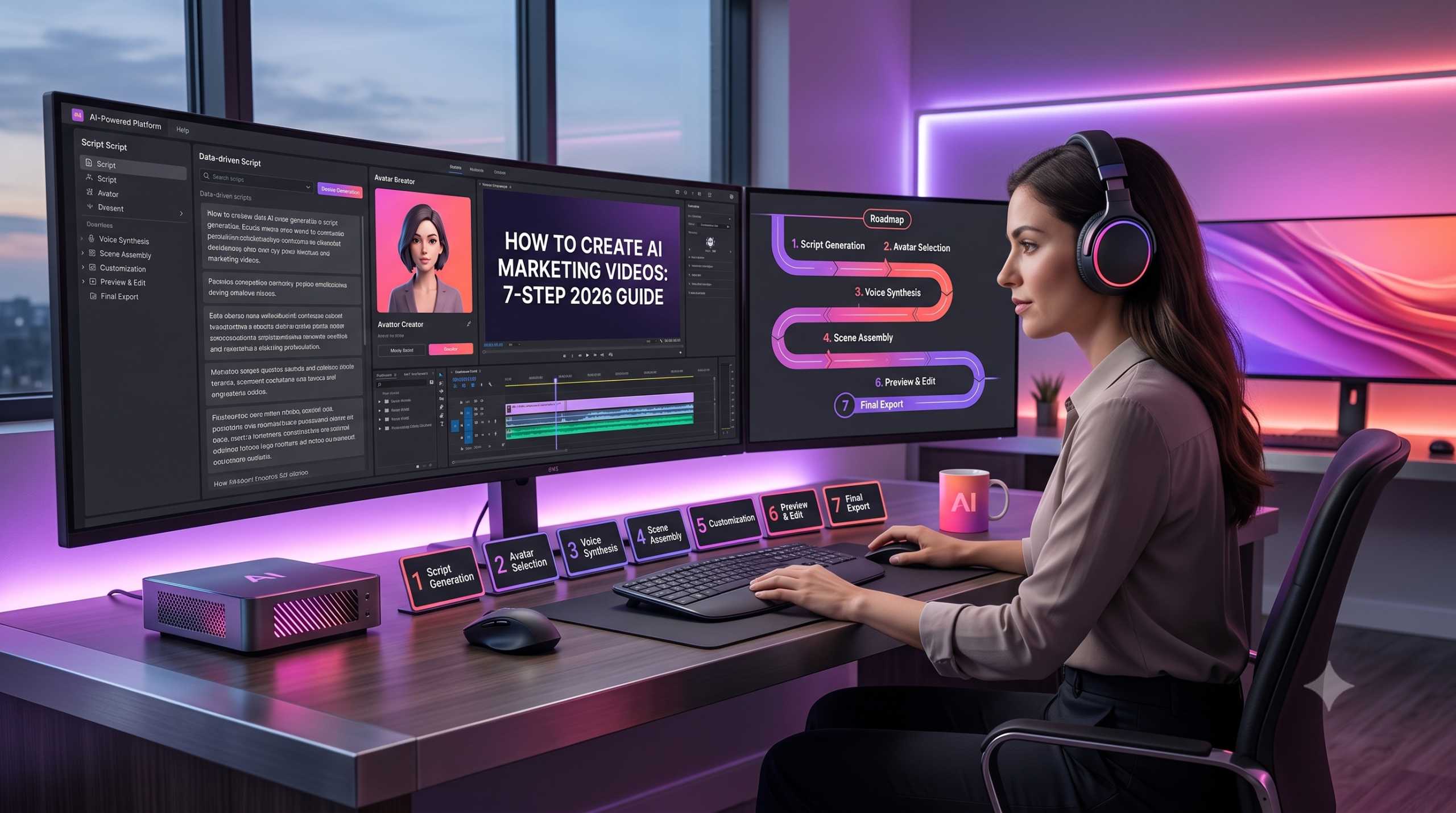
    For practical guidance on platform-specific video, see our 7-Step Guide to Creating AI Marketing Videos.

    “Repurposing” is not a hack—it’s a recipe for wasted spend and poor engagement. According to Think with Google, ads designed for mobile-first platforms deliver up to 3× higher engagement rates than re-cut TV spots.

    Iterate, Measure, and Optimise—Or Die Trying

    Video production does not end at upload. The fastest-growing brands treat every campaign as an experiment: launch, measure, revise, relaunch. A/B test hooks, CTAs, and even thumbnail images—don’t trust “gut feel” over data.

    • Analytics: Track view-through, drop-off points, and conversion rates using Google Analytics and platform-native dashboards.
    • Rapid Edits: Use AI-powered editors to test new captions, music, or hooks in hours, not weeks.
    • Retargeting: Integrate with ad platforms to retarget viewers who didn’t convert the first time.

    The new gold standard: iterate weekly, not quarterly. For more on modern video analytics and optimisation, check out AI-Powered Marketing Video Services: What to Expect.

    Ready to Ship High-Converting Videos?

    Stop wasting budget on “creative exploration.” Get a fixed-price, AI-powered marketing video—script to delivery—in under a week. Brief us your next campaign and see what a disciplined workflow can do for your conversion rates.

    Cost, Timelines, and What You Should Actually Pay

    Let’s get specific. In 2026, a 30-second social ad costs ₹25,000–₹75,000 and ships in 4–7 days if you use an AI-powered pipeline. Traditional agencies still quote 3–4× that price and take weeks longer. Why the gap? Human “busywork” that AI now automates—animation, voiceover, editing, and asset generation.

    Video Type AI-Powered Cost Traditional Cost Turnaround
    30s Social Ad ₹25,000–₹75,000 ₹80,000–₹2,00,000 4–7 days
    60–90s Explainer $3,000–$12,000 $10,000–$30,000 7–14 days
    Multi-language Dub +10% base cost +100% base cost +1–2 days

    For a detailed breakdown of AI and traditional production costs, see How Much Does AI Movie Production Cost?.

    Industry estimates from Statista show that up to 60% of video marketing spend is now allocated to AI-driven workflows. If you’re paying more, you’re subsidising inefficiency.

    Common Pitfalls (and How to Avoid Them)

    Even with the best tools, most marketing video projects stumble due to classic errors. Here’s what to watch for—and how to sidestep the traps.

    • Unclear Briefs: Vague goals or “make it viral” requests waste time and money. Insist on a one-page creative brief—audience, goal, key message, CTA.
    • Endless Revisions: Set a max of 2–3 revision rounds. More usually signals unclear direction, not creative perfectionism.
    • Ignoring Platform Needs: Don’t retro-fit 16:9 ads for TikTok—plan the format upfront.
    • Over-relying on AI: Let AI handle production grunt work, but keep creative oversight human.

    For brands looking to clarify their message and accelerate sales cycles with high-converting video content, explore our Marketing Videos service—AI-powered, human-directed, always results-focused.

    For further reading on the evolution of marketing video production, don’t miss MIT Technology Review’s analysis of AI video tools.

    How to Choose the Right Marketing Video Partner

    Not all “AI video studios” are equal. Look for partners who combine deep creative discipline with technical mastery—anyone can run a prompt through Sora, but few can shape a narrative that sells. Ask for real case studies, fixed pricing, and evidence of rapid delivery (not just “award-winning” claims).

    • Process transparency: Clear steps from brief to delivery, with timelines and milestones.
    • Strategy-first approach: Messaging and audience research before production begins.
    • Platform fluency: Experience producing for YouTube, LinkedIn, Instagram, and OTT.
    • AI + human blend: Both technical and creative leads on every project.

    To see how this works in practice, review our Marketing Videos service overview. Or, for a technical deep dive, read AI-Powered Marketing Video Services: What to Expect.

    FAQ — Marketing Video Production Best Practices

    What’s the ideal length for a marketing video in 2026?

    For most campaigns, 15–60 seconds hits the sweet spot. Instagram Reels and YouTube Shorts often perform best at 15–30 seconds. Explainers or demos can stretch to 90 seconds if every second delivers value. Longer videos usually see higher drop-off rates, especially on mobile. Always prioritise clarity and brevity over runtime.

    How does AI actually speed up marketing video production?

    AI automates time-consuming tasks: animation, VFX, voiceover, and even editing. For example, dubbing with ElevenLabs or animating with Runway can cut production timelines by 50–75%. The key is combining AI tools with a clear creative direction—automation is only effective when the vision is sharp.

    How much should I budget for a high-quality marketing video?

    Industry ranges in 2026: ₹25,000–₹75,000 for a 30-second social ad, $3,000–$12,000 for a 60–90 second explainer. Multi-language versions add ~10% to the base cost. If you’re quoted much higher, you’re likely paying for unnecessary manual work or agency overhead.

    What’s the most common mistake brands make?

    The biggest error is unclear messaging—trying to say too much or chasing “viral” trends without a core value proposition. The fix: use proven frameworks (PAS, AIDA), clarify your message up front, and tie every second of video to the campaign’s goal and audience pain point.

    Do I need different videos for different platforms?

    Yes. Each platform (Instagram, LinkedIn, YouTube) has unique format, length, and hook requirements. Repurposing a single video for all channels usually leads to poor engagement. The highest-performing brands design platform-first, optimising every edit for the context in which it will be watched.

    How many rounds of revision should I expect?

    2–3 rounds of revision is standard in AI-powered workflows. More than that typically signals an unclear brief or shifting goals. The best way to minimise revisions: lock messaging, storyboard, and shotlist before production begins.

    How do I measure if my marketing video is actually working?

    Track metrics like view-through rate, drop-off point, click-through rate (CTR), and conversions (form fills, sales, downloads). Use platform analytics and tools like Google Analytics to link video engagement to real business outcomes. A/B testing different hooks and CTAs is essential for ongoing optimisation.

    Where can I learn more about modern video production techniques?

    Start with the AI Video Production: The Complete 2026 Guide for a comprehensive overview. For practical case studies, check out 5 Inspiring Social Media Video Case Studies for Growth. For a technical breakdown of AI tools, see Top 7 AI Movie Production Tools Compared.

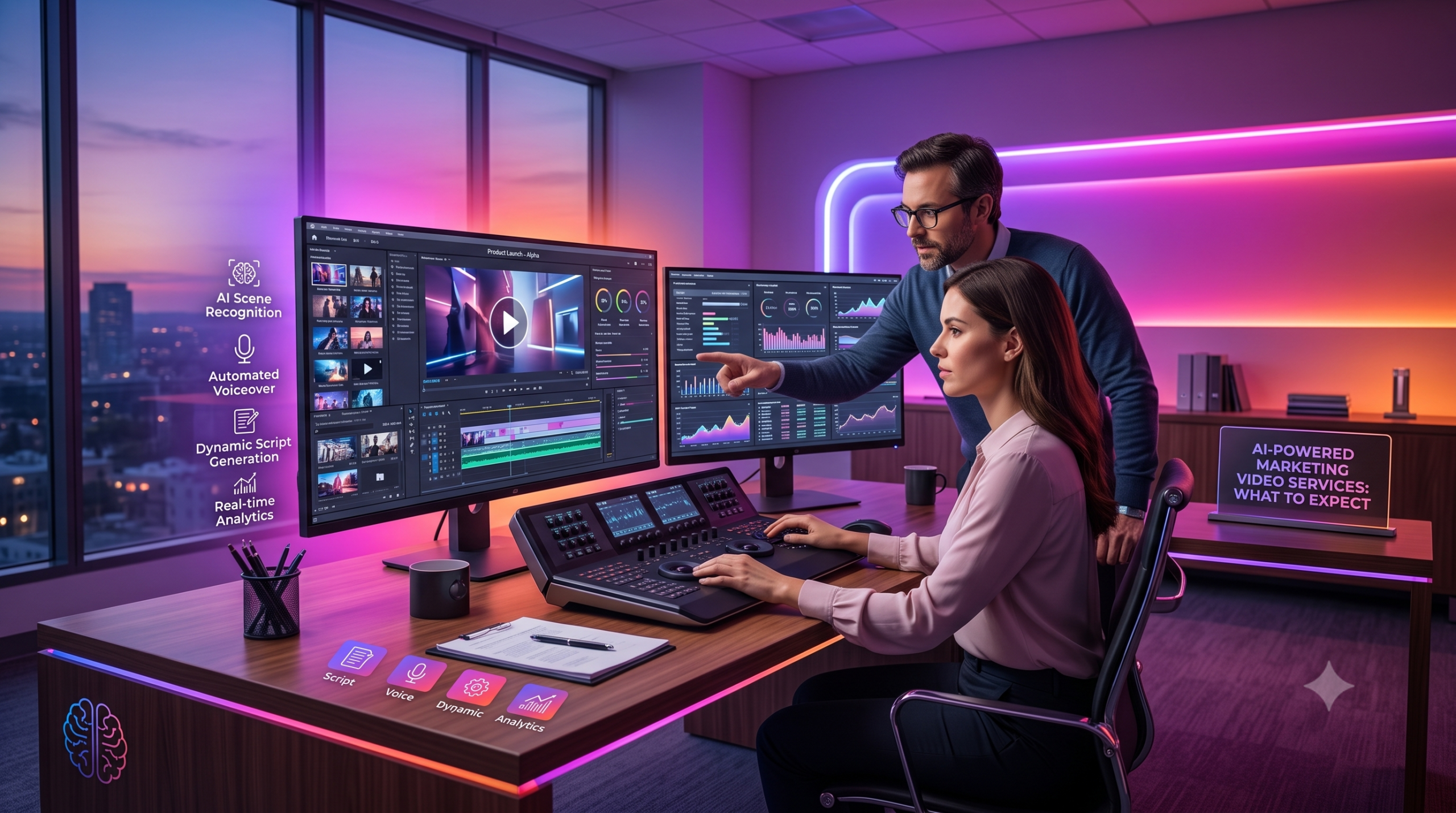
  • AI-Powered Marketing Video Services: What to Expect

    AI-Powered Marketing Video Services: What to Expect

    A product launch video that cost ₹50,000 and took 14 days in 2023 now ships in 3 days for ₹12,000—without sacrificing creative quality. AI marketing video services aren’t theory; they’re already driving 2–4× faster turnarounds and 30–50% lower costs for brands that need scroll-stopping content, not generic stock footage.

    TL;DR

    • AI marketing video services reduce production costs by 30–50% and cut lead times to 2–4 days for most projects.
    • Expect tailored scripts, brand-aligned visuals, and targeted messaging—not just templated animations.
    • New AI tools (Sora, Veo, Runway) enable effects, localisation, and creative storytelling previously out of reach for most brands.
    • Outcomes: higher conversion rates, more engagement, and measurable ROI on ad spend.

    What “AI Marketing Video Services” Actually Deliver

    Too many agencies sell “AI video” as a buzzword. In practice, real AI marketing video services combine human creative direction with AI-powered tools for scripting, editing, visual effects, and even multilingual voiceover. The result is not just faster output—it’s content that actually converts. Brands work with a creative lead who guides AI tools (like Runway, Pika, and ElevenLabs) to match the tone, pace, and audience of each campaign. No generic templates. No AI-for-the-sake-of-AI. You get a video mapped to your brief, with the speed and cost savings only possible in 2026.

    For a deeper dive into the entire production workflow, see AI Video Production: The Complete 2026 Guide.

    How AI Changes the Cost, Speed, and Quality Equation

    AI isn’t about replacing your creative team—it’s about removing the bottlenecks that slow down marketing campaigns. A 30-second product ad used to burn a week just on storyboarding and revisions. Now, AI tools generate script drafts, visual concepts, and even first-cut edits in hours. According to Statista data, over 61% of marketers using AI video production report faster campaign launches and 41% cite higher engagement rates.

    Video Type Traditional Cost/Timeline AI-Powered Cost/Timeline
    30s Social Ad ₹25,000–₹75,000
    7–14 days
    ₹10,000–₹35,000
    2–4 days
    60–90s Explainer $3,000–$12,000
    3–6 weeks
    $1,500–$5,000
    5–10 days
    Product Catalogue (10–50 SKUs) $300–$800 per SKU
    3–8 weeks
    $120–$350 per SKU
    1–2 weeks

    Quality isn’t sacrificed. AI tools like OpenAI’s Sora and Google Veo now output photorealistic video, while Runway and Pika automate rotoscoping, object removal, and motion graphics—tasks that used to eat up human hours and budget.

    What You Get: Deliverables and Use Cases

    AI marketing video services aren’t limited to one format. You can brief for:

    • Product launch videos with animated callouts
    • Explainer videos for SaaS and tech brands
    • Mobile-optimised ads for Instagram, Facebook, YouTube, LinkedIn
    • Brand storytelling with cinematic AI visuals
    • Multi-language video ads with AI voiceover
    • Short-form reels with dynamic transitions
    • Animated pitch videos for campaigns

    Each deliverable is tailored to your brand, target audience, and campaign objective. No two outputs look the same. AI enables rapid A/B testing: you can run three variants of a 15-second ad, see which one converts, and double down—without waiting weeks or blowing your budget.

    For a step-by-step breakdown of the process, see How to Create AI Marketing Videos: 7-Step 2026 Guide.

    How AI Video Services Personalise Messaging and Maximise Engagement

    Modern AI video platforms don’t just automate editing—they enable true personalisation at scale. Using customer data, AI can tailor hooks, voiceover, and visuals for specific segments. For instance, a B2B SaaS explainer might feature different product benefits for enterprise versus SMB viewers. AI-powered voice cloning (see ElevenLabs) makes rapid multi-language localisation realistic, not an afterthought.

    Dynamic creative optimisation (DCO) is now accessible to brands of any size. You can launch dozens of video ad variants, each with a different offer or CTA, and let algorithms optimise delivery based on real engagement metrics. As Think with Google notes, personalised video ads see 2–3× higher completion rates and up to 50% lower cost per acquisition compared to static campaigns.

    What the AI Workflow Looks Like (And What’s Still Human)

    AI handles the heavy lifting—drafting scripts, generating visuals, optimising edits—but you still get human creative direction. Here’s a typical workflow for a marketing video project in 2026:

    Stage AI’s Role Human Oversight
    Briefing Extracts key product features, target audience, desired outcomes from client input Producer clarifies messaging, sets creative direction
    Scripting Drafts multiple script options, suggests hooks and CTAs Writer polishes script, ensures brand alignment
    Visual Concepting AI generates moodboards, styleframes, and shot lists Creative lead selects and amends options
    Production Generates footage, applies AI-driven effects, composites assets Director reviews, requests changes, manages pacing
    Post-Production Automates editing, voiceover, localisation Editor fine-tunes, approves final cut

    This hybrid approach is why results don’t feel “AI-generated.” Your video is original, on-brand, and conversion-focused. The AI stack just gets you there in a fraction of the time.

    For a detailed look at how AI and human creativity combine, see AI vs Traditional Video Production: 7 Key Differences.

    Ready to brief your next marketing video?

    Stop waiting for “the perfect moment.” AI-powered video production now delivers high-converting content in days, not weeks. Get scroll-stopping ads, product explainers, or brand stories—tailored to your audience and budget. No obligation, no hidden costs.

    Real-World Outcomes: What Brands See from AI Video Campaigns

    It’s not just theory—brands using AI marketing video services are seeing tangible results. Typical outcomes include:

    • Conversion rates up 15–40% versus static image ads (backed by HubSpot’s State of Marketing report)
    • 60–80% lower cost per video variant for A/B testing
    • Faster campaign launches—2–4 days versus 2 weeks
    • Brand recall and message clarity scores improved by 25%+
    • Significant uplift in social engagement (shares, comments, saves)

    One B2B SaaS client replaced a text-heavy explainer with a 60-second AI-powered video and saw demo signups increase by 38% in the first month. E-commerce brands running AI-generated product reels on Instagram have reported cost-per-acquisition dropping by half, with no loss in visual quality.

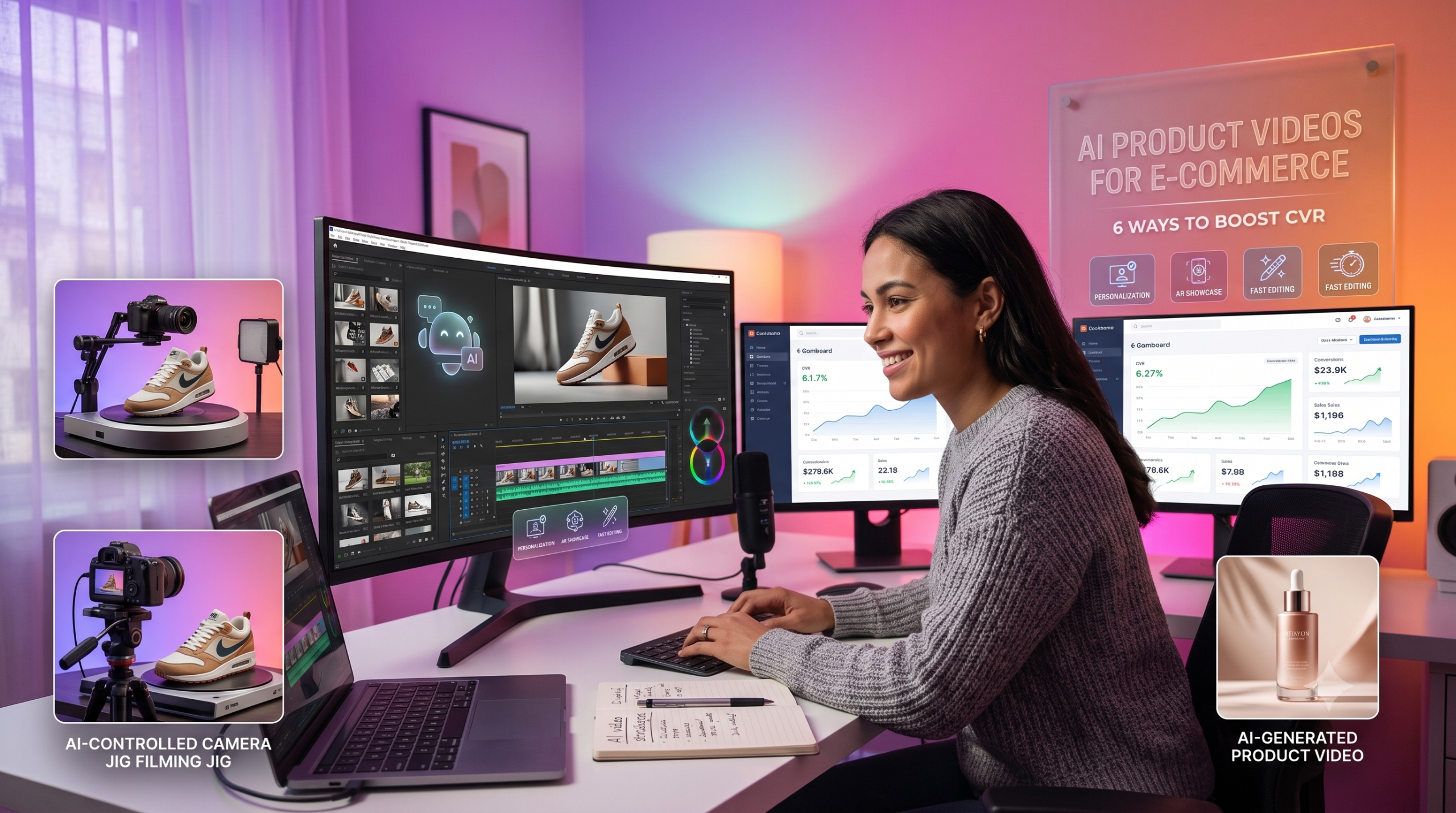
    To see how this plays out in e-commerce, read AI Product Videos for E-commerce: 6 Ways to Boost CVR.

    What’s Included (and What’s Extra) in a Modern AI Video Service

    Most reputable AI marketing video services include:

    • Scriptwriting and creative direction
    • AI-powered animation, visual effects, and editing
    • Brand-aligned voiceover (human or AI-cloned)
    • Multi-language localisation
    • Up to 2–3 rounds of revisions
    • Platform-optimised versions (1:1, 9:16, etc.)

    Extras may include:

    • Live-action shoots (hybrid with AI effects)
    • Custom 3D assets or advanced compositing
    • Extensive usage rights or exclusive stock
    • Long-form documentary/brand films

    If you’re comparing providers, ask for a transparent breakdown of inclusions and turnaround times. A credible agency should give you a fixed quote and timeline up front—no “hidden” AI upcharges. For our own offering, see Marketing Videos.

    For a full cost breakdown, check AI Video Production Cost in 2026: Full Pricing Guide.

    Risks, Myths, and What to Watch Out For

    AI marketing video services aren’t “set and forget.” Weak briefs and poor human oversight lead to generic, off-brand content. Watch out for agencies that promise “fully automated” video—no real brand would ship outputs without creative review. Also, copyright and authenticity matter: ensure your provider uses C2PA-compliant tools (see C2PA standards) and can guarantee commercial usage rights for all AI-generated assets.

    Finally, remember: AI is not a creative substitute—it’s a force multiplier. The best results come from pairing technical capability with sharp storytelling and clear marketing objectives.

    If you want the full workflow, see AI Video Production: The Complete 2026 Guide.

    FAQ — AI Marketing Video Services

    How fast can I get a finished marketing video using AI services?

    For most 30–60 second marketing videos, you can expect a 2–5 day turnaround—sometimes even faster for simple briefs or social ads. More complex projects (multi-language, advanced effects) may take 7–10 days. This is 2–4× faster than typical agency timelines.

    Is the quality on par with traditional video production?

    Yes. Modern AI tools (like Sora, Veo, Runway, Pika) now match or exceed the visual quality of most traditional workflows, especially for digital ads, explainers, and product reels. The key is creative oversight—AI handles the execution, but humans ensure the result is on-brand and compelling.

    What types of marketing videos can AI services create?

    Almost any format: product launches, explainers, demo videos, brand stories, social ads, mobile-optimised reels, and multi-language campaigns. AI accelerates production for all digital-first video types, with customisation for different platforms and audiences.

    Is my brand’s data or creative IP safe with AI video providers?

    Reputable providers use secure, enterprise-grade AI platforms and comply with international data protection standards. Always confirm that your agency offers NDAs and uses C2PA-compliant tools to ensure asset authenticity and copyright safety.

    How much do AI marketing video services cost in 2026?

    Typical pricing: ₹10,000–₹35,000 for a 30-second social ad; $1,500–$5,000 for a 60–90 second explainer; $120–$350 per SKU for e-commerce catalogues. Multi-language dubbing and rapid variant generation are often included. Always ask for a fixed quote upfront.

    Can I request edits or revisions to an AI-generated video?

    Absolutely. Any credible AI video service includes at least 2–3 rounds of revisions. The workflow is collaborative: you review drafts, give feedback, and only sign off when the video matches your goals and brand standards.

    What’s the difference between AI video tools and full-service AI video agencies?

    DIY AI tools let you generate quick videos, but you’re on your own for scripting, brand alignment, and creative polish. Full-service agencies pair AI with human creative direction, so you get custom scripts, platform-optimised edits, and higher conversion rates—without the learning curve.

    Where can I see real examples or get a quote?

    Visit the Marketing Videos service page for examples, or hand us your brief for a fixed-price quote in 24 hours. You’ll get a transparent breakdown of deliverables, timeline, and pricing—no obligation.

  • How to Create AI Marketing Videos: 7-Step 2026 Guide

    How to Create AI Marketing Videos: 7-Step 2026 Guide

    The mechanics of how to create AI marketing videos aren’t a secret anymore — they’re a workflow. Seven stages, run in order, deliver a launch-ready marketing video in 5–10 working days at a fraction of traditional cost. This is the process serious AI-first studios use, the one we run for clients ranging from D2C brands to enterprise SaaS. No magic tool, no single prompt — just a tight pipeline you can replicate or hand to a partner.

    TL;DR — the 7 steps

    1. Brief — audience, action, message, constraints.
    2. Script — AI-drafted, human-edited, beat-checked.
    3. Storyboard — generated frames or shot list, locked before generation.
    4. Generate — footage, voice, music, in that order.
    5. Edit — assembly, color, motion graphics, brand polish.
    6. QA — brand, legal, disclosure, platform specs.
    7. Launch & variant — multi-cut for each placement, A/B at launch.

    Step 1 · Write a tight brief

    The single biggest predictor of how an AI marketing video turns out is how tight the brief is. Models interpret words literally — vague briefs produce vague videos. A working brief covers six things, on one page:

    • Audience. One sentence describing who this is for and what they currently believe or do.
    • Action. The one thing you want them to do after watching — install, sign up, click through, remember a brand.
    • Message. The one idea that, if they only remember it, the video has worked.
    • Format constraints. Where it runs (Reels, Shorts, CTV, YouTube pre-roll, landing page), length, aspect ratio, sound-on or sound-off.
    • Brand rails. Logo treatment, colors, do’s and don’ts, mandatory legal lines.
    • Reference. Two or three videos you wish yours looked like — and one or two it absolutely shouldn’t look like.

    If your brief is more than one page, it’s a project plan, not a brief. Trim ruthlessly.

    Step 2 · Draft the script with AI, edit like a human

    A 30-second marketing video is roughly 65–75 spoken words. A 60-second one runs 130–150. Tight constraint — and AI is genuinely useful here, because it can generate 20 variants in under a minute and let you pick the angle that lands.

    The workflow:

    1. Paste the brief into a large language model (Claude, GPT, Gemini).
    2. Ask for 5–10 script variants in different angles — problem-first, benefit-first, story-first, demo-first.
    3. Pick the strongest opener and the strongest close. They’re often from different drafts. Stitch.
    4. Read the final script aloud. If you stumble, rewrite the line.
    5. Lock the script with a beat sheet (every 2–3 seconds, what’s happening visually and what’s being said). This is what feeds the next stage.

    Three things the AI script will not get right out of the box: brand voice, regulatory phrasing in regulated industries, and inside-jokes / cultural references for a specific audience. Always human-edit those.

    Step 3 · Storyboard before you generate

    The most expensive mistake in AI video production: generating footage before you’ve locked the storyboard. Every generation pass costs time and compute. Iterating on a wrong shot list is what blows project timelines.

    For each beat in the script, define:

    • What’s in frame (subject, setting, camera angle, lens, motion).
    • Duration in seconds.
    • The transition into the next shot.
    • The intended emotion or moment.

    Use a visual model (Midjourney, Imagen, Ideogram) to generate reference frames for each shot. These aren’t the final footage — they’re alignment checkpoints. A storyboard of 12–18 reference frames, signed off by the brand owner, will save you four revision rounds downstream.

    Step 4 · Generate footage, voice, and music

    Run generation in this order: footage first, voice second, music last. The reason: footage timing is the least predictable variable. Once shots are locked, voice and music can be precisely fitted to the final cut.

    4a · Footage

    Feed each storyboard frame as a starting image into a generative video model (Sora, Veo, Runway, Kling). Generate 3–5 takes per shot. Pick the best take. Expect a 30–50% acceptance rate on first pass — that’s normal. Reroll the rest.

    4b · Voice

    Generate the voiceover in your chosen voice tool (ElevenLabs, PlayHT, Resemble). For brand work, train or load a brand-voice clone with consented training audio. For B-tier content, synthetic stock voices are usually indistinguishable from human VO at this length.

    4c · Music

    Generate or license an original track. AI music tools (Suno, Udio, Stable Audio) now produce commercial-grade scores with cleared rights. Match the track’s tempo and energy curve to the cut, not the other way around.

    Step 5 · Edit, color, brand polish

    Assembly happens in a real editor — Premiere, DaVinci Resolve, Final Cut, or CapCut for fast social workflows. AI assists, but the editor’s craft still drives the cut. Three things to nail:

    • Pace. The single most common failure mode of AI marketing video is shots that hold too long. Cut 10–15% tighter than feels right.
    • Color & brand match. Generated footage will rarely match your brand palette out of the box. A LUT pass and a brand grade are mandatory.
    • Motion graphics. Lower-thirds, callouts, product UI overlays, and the CTA card. These are still mostly hand-built in After Effects or motion templates, and they’re where craft shows.

    Step 6 · QA — brand, legal, disclosure, platform

    Before launch, run a four-part QA pass:

    1. Brand QA. Logo, color, font, do’s-and-don’ts. The brand owner signs off.
    2. Legal QA. Required claims and disclaimers, talent and likeness clearances, music and stock licensing. In regulated industries (finance, pharma, kids) this is non-negotiable.
    3. AI disclosure. Most platforms now require AI-generated or AI-altered content to be labeled. Add the platform disclosure flag at upload (and embed C2PA content credentials if your tools support it). Full handbook in The Ethics of AI Video Production.
    4. Platform spec QA. Aspect ratio, file size, codec, captions, audio loudness. Each platform has its own specs — get them right before upload or the ad gets rejected.

    Step 7 · Launch with variants, not a single cut

    The biggest mistake teams new to AI video make: producing one beautiful hero cut and stopping. AI’s main advantage is variant economics — making 5–10 cuts of the same video costs marginally more than making one.

    At launch, ship at minimum:

    • Three aspect ratios. 9:16 for Reels/Shorts/TikTok, 1:1 for feed, 16:9 for YouTube and landing pages.
    • Two lengths. A 6-second hook for pre-roll and skippable formats, plus the full version.
    • Two openers. Test different first 1.5-second hooks. Hook is 60% of performance — A/B it day one.
    • Localized variants. If you serve multiple language markets, AI dubbing in 3–10+ languages should be in the launch package, not an afterthought.

    Want the 7-step process run for you?

    Share the brief — we run all seven steps in 5–10 working days and ship a multi-variant launch package, not a single cut. Fixed pricing, 24-hour response.

    5 mistakes that wreck AI marketing videos

    1. Generating before storyboarding. Every iteration starts from scratch. Lock the shot list first.
    2. Trusting the first take. Generate 3–5 takes per shot. The first one is rarely the best.
    3. Skipping the brand grade. Raw generated footage doesn’t sit on brand. Always do a color pass.
    4. One cut only. No platform variants, no length variants, no A/B hooks. Wasting AI’s biggest advantage.
    5. No disclosure flag. Platforms downrank or block content that should have been labeled. Label at upload.

    FAQ — creating AI marketing videos

    How long does it take to create an AI marketing video?

    A 30–60 second AI marketing video takes 5–10 working days end-to-end through a professional 7-step pipeline. Templated short-form variants can ship in 2–5 days. Brand films and explainers run 2–3 weeks.

    What tools do I need to create AI marketing videos?

    At minimum: an LLM for scripts (Claude, GPT), a video generator (Sora, Veo, Runway, Kling), a voice tool (ElevenLabs), a music generator (Suno, Udio), and an editor (Premiere, DaVinci, or CapCut). For tool-by-tool reviews, see 15 Best AI Video Tools for Instagram Reels & Short-Form.

    Can I create AI marketing videos without technical skills?

    For simple social content with templated tools — yes. For brand-quality marketing video where consistency, rights, compliance, and platform-fit variants matter, a production studio is still faster and cheaper than self-serve, because the long tail of failed generations and revision cycles hides in the per-project math.

    How much does it cost to create an AI marketing video?

    $300–$1,500 for a templated short-form ad. $2,000–$8,000 for a bespoke 30–60 second spot. $3,000–$12,000 for a 90-second explainer. The full breakdown is in AI Video Production Cost in 2026: Complete Pricing Breakdown.

    What makes an AI marketing video convert?

    Strong opening hook in the first 1.5 seconds, single clear message, native format for the placement (vertical for Reels, captioned for sound-off feed), a defined CTA, and at-launch A/B variants. The video that performs is almost always one of several you tested — not a single hero.

    Do I need to disclose that the video was made with AI?

    Yes, on every major platform in 2026 (Meta, YouTube, TikTok, LinkedIn). Most platforms apply labels automatically when C2PA content credentials are embedded. Manual labeling at upload is required when the platform can’t auto-detect.


  • AI Explainer Videos for SaaS: A 9-Step Playbook (2026)

    AI Explainer Videos for SaaS: A 9-Step Playbook (2026)

    A good AI explainer video is the highest-ROI piece of content a SaaS team can ship in 2026. It runs on the homepage, lives at the top of every sales deck, sits in every nurture sequence, and gets repurposed into 30+ Reels and ad cuts. Done right, it lifts demo conversion 25–40% and shortens the sales cycle by weeks. Done wrong, it’s a generic narrator-over-screen-recording that the prospect skips at 4 seconds. This is the 9-step playbook serious SaaS teams use.

    TL;DR — the 9-step playbook

    1. Pick the job-to-be-done and one buyer persona.
    2. Open on the problem, not the product.
    3. Use one of three proven script frameworks (PAS, AIDA, JTBD).
    4. Hold the video to 60–90 seconds.
    5. Show the product UI for ~30% of runtime — no more.
    6. End with a single, specific CTA.
    7. Ship a multi-cut launch pack: full, 30s, 15s, 6s, captioned, with founder VO option.
    8. Distribute across website hero, sales, email, ads, social, sales-enablement.
    9. Measure completion rate, demo-CTA click-through, demo-conversion delta.

    Why SaaS explainers are an outsized lever

    An explainer video is the only content asset that scales across every motion: marketing (homepage), sales (decks & emails), customer success (onboarding), and recruitment (employer brand). For SaaS specifically, three things compound:

    • Product complexity shrinks. A great explainer makes a complex product feel obvious — and obvious products convert.
    • Sales cycles compress. Prospects who watch a good explainer arrive at first call already qualified on category and problem fit.
    • Trust is borrowed forward. The video shows you can communicate clearly — a strong proxy for whether the product itself will be clear.

    The 2026 unlock is that all of the above used to require a $20K–$60K production. With AI, the same quality bar lands at $3K–$12K — covered in detail in AI Video Production Cost in 2026.

    Step 1 — Pick the job-to-be-done and one persona

    Most SaaS explainers fail because they try to speak to every buyer about every feature. A working explainer picks one persona and one job they’re hiring software to do. That’s the brief.

    Bad opening: “Our platform helps companies streamline operations across teams.” Good opening: “When the product launch slips because the legal review took six days, the marketing team finds out on Slack at 11pm on a Sunday.”

    Step 2 — Open on the problem, not the product

    The first 5 seconds decide whether someone watches the next 55. Open with the painful, specific, recognizable moment — not the brand name, not the logo, not the product UI. If the viewer is in your ICP, they should think “that’s me” before you’ve said what you sell.

    Step 3 — Pick a proven script framework

    PAS — Problem · Agitate · Solution

    Set up the pain → twist the knife → reveal the fix. Best for sharp single-problem categories (security, compliance, customer support).

    AIDA — Attention · Interest · Desire · Action

    Hook → expand the world → show transformation → ask. Best for broader categories and platforms.

    JTBD — Situation · Motivation · Outcome

    Show the specific situation → reveal what they really want → demonstrate the outcome. Best for nuanced B2B sales where the buyer hires software for an outcome, not a feature.

    Step 4 — 60–90 seconds, no exceptions

    The sweet spot is 75 seconds. Under 60 and you can’t earn trust. Over 90 and completion rates drop off a cliff. We measure this across hundreds of explainer projects: median completion at 60s = 78%, at 90s = 64%, at 120s = 41%. The arithmetic is simple: a tighter video, watched fully, beats a longer one, half-watched.

    Step 5 — Show the product for ~30% of runtime

    This is the single number most SaaS teams get wrong. They want to show the product for 80% of the runtime. The right number is around 30%. The rest of the time is on the buyer’s world, the problem, the metaphor, and the outcome.

    Use AI-generated B-roll for the non-product 70%. Generated office shots, abstract environments, problem-space metaphor footage — this is exactly where AI video shines and where a traditional shoot would blow the budget.

    Step 6 — One CTA, specific and time-bound

    Bad: “Learn more.” Better: “Book a demo.” Best: “Book a 20-minute call this week — we’ll show you the launch-tracking dashboard in your own data.”

    Pick one. Don’t list three. The video that asks for one specific action outperforms the video that gives the viewer a menu.

    Step 7 — Ship a multi-cut launch pack

    The 75-second master is the start, not the deliverable. Each launch ships with:

    • 75s master (homepage, sales deck, email)
    • 30s cut (paid social, sales follow-up)
    • 15s cut (top-of-funnel ads)
    • 6s hook (pre-roll, retargeting)
    • Vertical 9:16 (LinkedIn video posts, Reels, Shorts)
    • Square 1:1 (LinkedIn feed, Meta feed)
    • Captioned versions (sound-off feed, accessibility)
    • Founder-VO alt (optional, for warmer outreach)

    AI workflows generate these from one approved master at marginal cost — the entire reason explainers became economical in 2026.

    Step 8 — Distribute everywhere

    Surface Cut Why it works
    Website hero 75s muted with captions, autoplay Lifts demo-CTA click 25–40%
    Sales deck slide 1 75s Aligns the buyer on what you do in <90 seconds
    Cold email 15s GIF preview → click to 75s 3× reply rate vs text-only
    LinkedIn organic 30s square, captioned Founder-VO version drives engagement
    Meta & LinkedIn ads 6s + 15s Hook variants for CPM optimization
    Sales enablement 75s SDR & AE training; demo prep for prospects
    Onboarding 75s New customers re-watch on day 1

    Step 9 — Measure the three metrics that matter

    1. Completion rate. What % of viewers watch ≥75%? Target > 60% for the master.
    2. CTA click-through. Of completers, what % click “Book demo”? Target > 15%.
    3. Demo-conversion delta. Does the demo book-to-close rate move when the prospect watched the explainer beforehand? This is the real ROI number.

    Need a SaaS explainer that lifts demo bookings?

    We ship the 9-step playbook as a fixed-scope project. 75s master + full multi-cut launch pack, 2–3 weeks from brief to delivery, transparent pricing.

    FAQ — AI explainer videos for SaaS

    How long should a SaaS explainer video be?

    60–90 seconds for the master. Median completion at 60s is ~78%; at 120s it drops to ~41%. Shorter, fully-watched videos outperform longer, half-watched ones across every funnel metric.

    How much does an AI explainer video cost for SaaS?

    A bespoke 60–90 second AI explainer typically runs $3,000–$12,000 including script, AI generation, voiceover, music, motion graphics, and a multi-cut launch pack. See the full pricing breakdown.

    Should the explainer show the product UI?

    Yes — for about 30% of runtime. The rest should be on the buyer’s world, the problem, and the outcome. Showing UI for 80% of the runtime is the most common SaaS explainer mistake.

    What script framework works best for SaaS explainers?

    PAS (Problem-Agitate-Solution) for sharp single-problem categories like security or compliance. JTBD (Situation-Motivation-Outcome) for nuanced B2B sales. AIDA for broader platforms. Pick one and follow it — don’t blend three.

    Where should I host my SaaS explainer?

    Self-host via Mux, Wistia, or Vidyard for the homepage and sales surfaces (lets you measure completion and pixel ad audiences). Mirror on YouTube for SEO and discoverability. Avoid embedding only from YouTube on your homepage — you lose attribution and analytics.

    How long does it take to make a SaaS explainer with AI?

    2–3 weeks from brief to delivery of the multi-cut launch pack. The brief and script stage takes the longest — generation, edit, and finishing fit inside the back half.

    Can I use AI voice instead of human VO?

    For most SaaS audiences in 2026 — yes, AI voice is indistinguishable from human VO at explainer length. Use a brand-voice clone for consistency across cuts and languages. For founder-led storytelling, use the founder’s real voice (or a consented clone of it).


  • AI Product Videos for E-commerce: 6 Ways to Boost CVR

    AI Product Videos for E-commerce: 6 Ways to Boost CVR

    A static product photo and a few bullet points used to be enough. In 2026 it isn’t. The PDPs that win on conversion have AI product videos — sub-15-second loops, 30-second hero clips, lifestyle shots, and Reels-native cuts — generated at SKU scale without a photographer or a shoot day. This is the practical guide: six conversion-tested formats, benchmarks for each, the platform-by-platform spec sheet, and a build-vs-outsource decision tree.

    TL;DR — AI product video impact

    • PDPs with product video typically lift conversion 30–80% vs photo-only listings (varies by category, price, and audience).
    • Six formats deliver the bulk of that lift: 360 loop, lifestyle clip, demo, comparison, UGC-style, problem-solution.
    • AI workflows ship 10–200 product videos in the time and cost of one traditional shoot.
    • Build in-house if you ship 50+ SKUs/month with consistent format needs; outsource if quality bar and on-brand polish are the priority.

    PDP conversion benchmarks — video vs photo

    The conversion lift from adding product video isn’t a single number — it varies meaningfully by category. The most useful benchmark ranges from major e-commerce analytics platforms and our own client data through 2025–26:

    Category Typical PDP CVR lift with video
    Apparel & fashion +40–80%
    Beauty & personal care +50–90%
    Home & furniture +30–60%
    Electronics & gadgets +25–50%
    Food & beverage +30–55%
    Toys & baby +45–75%
    Tools & hardware +20–40%

    The lift compounds when video is paired with smart placement — autoplay (muted) within the gallery, with the photo grid as fallback. Hidden behind a play button only, the lift falls off significantly.

    The 6 product video formats that move conversion

    1 · 360° product loop (15 seconds)

    The most basic and most universally effective. AI generates a clean 360° spin on a brand-coloured backdrop from 3–5 reference photos. Auto-plays muted on PDP. Lift: +20–40% on its own. Best for: every category, every SKU, default.

    2 · Lifestyle clip (10–20 seconds)

    The product in use, in context — a kitchen utensil on a hand chopping vegetables, a watch on a wrist in a meeting, a chair in a styled living room. AI generates from reference imagery + prompt-driven scene composition. Adds aspirational context without a photoshoot. Lift: +30–60% when paired with the 360 loop. Best for: apparel, beauty, home, lifestyle goods.

    3 · Demo / how-it-works (20–30 seconds)

    Show the key feature in action. For electronics: the interface. For appliances: the result. For tools: the use case. Sub-30s, captioned, no music required. Lift: +25–50% with substantial returns-rate improvement. Best for: electronics, appliances, tools, complex products.

    4 · Comparison / size & scale (10 seconds)

    Product next to common reference objects (a coffee cup, a phone, a hand). Solves the #1 reason for returns: “I expected it bigger / smaller.” Lift: moderate on conversion (+10–20%), significant on returns reduction (-20–40%). Best for: home goods, furniture, accessories, toys.

    5 · UGC-style testimonial (15–30 seconds)

    Authentic-feeling user voice — AI avatars or licensed creator-style clips with the product. The 2026 evolution of star reviews. Triggers social proof without a celebrity budget. Lift: +30–55% when placed in the review section of a PDP. Best for: beauty, fashion, supplements, anything with high consideration.

    6 · Problem–solution (20–30 seconds)

    Open on a recognizable pain point, reveal the product as the solution. This is your Reels & TikTok-ad format, but works on PDP for problem-solving products. Lift: +40–70% on PDPs for problem-driven products. Best for: cleaning, organization, kitchen gadgets, baby and pet products.

    Platform-by-platform PDP specs

    Platform Aspect ratio Recommended length Autoplay
    Shopify PDP 1:1 or 4:5 15–30s Yes (muted)
    Amazon listing 16:9 15–30s Yes (muted)
    Flipkart listing 1:1 10–20s Yes (muted)
    Meta & Instagram Shop 4:5 or 9:16 15–60s Yes
    TikTok Shop 9:16 15–30s Yes
    YouTube Shopping 9:16 or 16:9 15–60s Yes

    UGC + AI — the new authenticity

    Real UGC is still the gold standard. But AI now fills the gap: AI-generated UGC-style content — same handheld camera feel, same imperfect framing, same naturalistic voiceover — performs within 10–15% of real UGC for many categories at 1/20th the cost.

    Best practice: seed your video library with real creator UGC, then scale variants and translations via AI. Disclose AI use at upload per platform rules.

    Build vs outsource — decision tree

    • Build in-house if: you ship 50+ SKUs/month with consistent format needs, you have a designer or video editor on staff, and your brand is “good enough” rather than “best in class.”
    • Outsource if: your hero PDPs need to look on-brand and polished, you need 6 formats per SKU, or you’re entering a new category and want a strong launch.
    • Hybrid: outsource hero PDPs and the brand template, then run high-volume long-tail SKUs in-house using the established template.

    For the tools to build in-house, see 15 Best AI Video Tools for Instagram Reels & Short-Form. For the underlying workflow and quality bar, see How to Create AI Marketing Videos: A 7-Step Process.

    Product videos for your full catalogue?

    We build per-SKU AI product video at scale — 360 loops, lifestyle clips, demos, comparisons, UGC-style cuts. Catalogue pricing from 10 SKUs upward.

    5 mistakes that wreck product video ROI

    1. One video per product, every product the same. Different categories need different formats. Don’t apply 360 spins to apparel.
    2. Sound-required. Default to sound-off for PDPs and feed. Reserve sound-on for product pages, Reels, and dedicated content.
    3. Over-stylized B-roll. Lifestyle clips that feel like a perfume ad don’t convert utility products. Match aesthetic to category.
    4. Hidden behind a play button. Autoplay (muted) for the gallery; cuts the lift in half if it requires a click.
    5. No size reference. Comparison shots cost almost nothing and meaningfully reduce returns. Always include one in the gallery.

    FAQ — AI product videos for e-commerce

    Do AI product videos really boost e-commerce conversion?

    Yes — typical PDP conversion lift ranges from 30–80% depending on category. Beauty, apparel, and lifestyle products see the highest lift. Tools and hardware see the smallest.

    How much do AI product videos cost?

    Catalogue projects typically run $300–$800 per SKU when batched at 10+ SKUs. Single bespoke product videos range $500–$3,000. The economics are dramatically better than traditional photo+video shoots which often run $300–$1,000 per SKU just for photography.

    Can AI generate product video from photos?

    Yes — 3–5 reference photos from different angles are enough to generate a 360° loop, lifestyle clip, or demo video. No shoot required.

    What’s the best length for an e-commerce product video?

    15–30 seconds for PDP and listings. 15–60 seconds for Reels-style placements. Under 15 seconds for ad placements. Longer than 60s drops completion significantly outside of YouTube product pages.

    Should I use AI UGC for product videos?

    For high-volume long-tail SKUs, yes — performance is within 10–15% of real UGC at a fraction of cost. For hero products, seed with real creator content first, then scale variants with AI. Disclose AI use at upload per platform rules.

    Do I have to disclose AI-generated product videos?

    Yes on most major platforms in 2026 — Meta, TikTok, YouTube, and several marketplaces require AI-generated content to be labeled. Most major AI tools embed C2PA content credentials that platforms detect automatically.