
What took ₹25 crore and 12 months in VFX work for a Bollywood feature in 2022 now ships for under ₹5 crore and 10 weeks using an AI-powered movie production pipeline—without compromising cinematic quality.
TL;DR
- AI movie production slashes VFX and post costs by 60–80%, with blockbuster effects on indie budgets.
- AI tools accelerate timelines—weeks instead of months for editing, compositing, and upscaling.
- Scriptwriting, storyboarding, VFX, and 4K upscaling are now automated or AI-assisted, but creative direction remains human-led.
- Studios, indies, and OTT creators all benefit—if they know what to automate and what not to.
The Real Meaning of “AI-Powered” in Movie Production
Strip away the hype: AI-powered movie production isn’t about a robot replacing your director or actors. It’s about using advanced AI tools to automate or supercharge the most expensive, slowest, and most repetitive parts of filmmaking—VFX, background replacement, upscaling, rough cuts, and even script drafts. The result: cinematic quality on a fraction of the traditional budget, with timelines that make traditional studios look archaic.
How the AI Movie Pipeline Actually Works
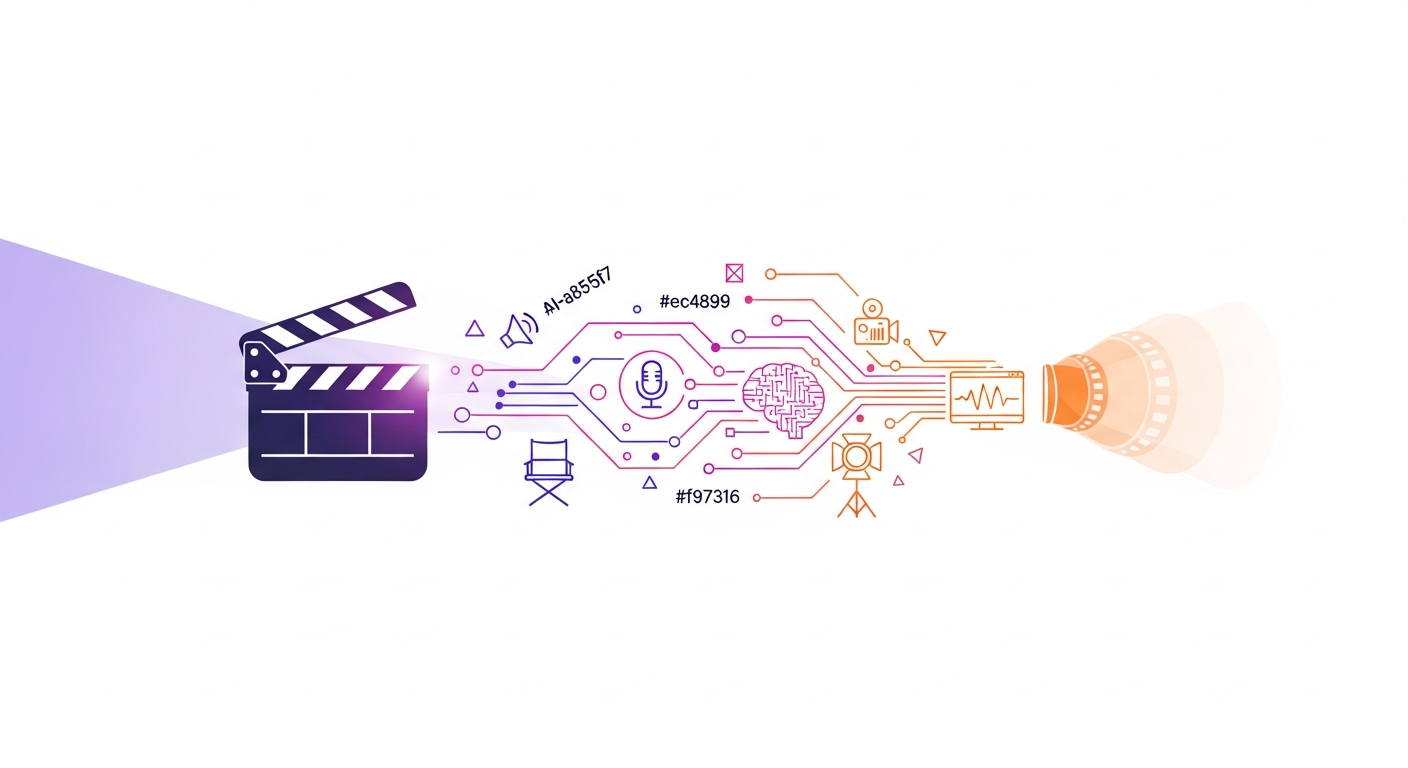
Picture a modern AI pipeline as a series of modular tools, each tackling a production bottleneck. Here’s a simplified breakdown of how a feature or trailer might flow:
| Stage | AI Tool/Method | Traditional Cost/Time | AI Pipeline Cost/Time |
|---|---|---|---|
| Scriptwriting | Generative AI (Claude, Gemini) | ₹1–2 lakh, 2–6 weeks | ₹30k–₹80k, 2–4 days |
| Storyboarding | Image Gen (Midjourney, DALL-E) | ₹80k+, 2 weeks | ₹15k–₹40k, 2 days |
| Backgrounds & Sets | Video Gen (Sora, Veo, Runway) | ₹5–15 lakh, 1–2 months | ₹1–3 lakh, 1–2 weeks |
| VFX/Compositing | AI rotoscoping, generative fill | ₹10+ lakh, 2–3 months | ₹2–4 lakh, 2–3 weeks |
| Restoration/Upscaling | Neural upscaling (Imagen, Topaz) | ₹2–5 lakh, 4 weeks | ₹40k–₹1 lakh, 3–5 days |
This isn’t theoretical. Vidxen’s real client work has seen VFX budgets drop from $2.5M+ to under $400k for major sequences, with 4–5× faster delivery.
What AI Can (and Can’t) Automate in Film Production
AI excels at the technical and repetitive—background removal, upscaling, rotoscoping, and even basic script drafts. It generates photorealistic backdrops (see OpenAI Sora demos) and can “restore” grainy 1980s footage to pristine 4K. But here’s where the industry gets it wrong: AI doesn’t replace your director, cinematographer, or editor-in-chief. Human vision, taste, and decision-making are still non-negotiable for anything cinematic.
- Automated by AI: VFX compositing, background replacement, dialogue clean-up, colour grading, 4K upscaling, script outlines, rough storyboards
- Always human-led: Final direction, actor performance, editing rhythm, creative shot design, story pacing
Studios using AI as a force multiplier—not a replacement—are the ones winning in both quality and budget.
Blockbuster Quality on Indie Budgets: What’s Possible Now
2026’s indie filmmakers are producing feature-level VFX and 4K remasters for what used to be “short film” budgets. Generative tools like Google Veo and Runway let you create sweeping cityscapes or fantasy worlds without a single green screen. AI-powered upscaling means you can restore decades-old archival footage for OTT in days. The difference is visible—literally:
| Old Model | AI Model |
|---|---|
| ₹2–5 crore VFX for 10 min sequence | ₹40–80 lakh, same quality |
| 4 months for post-production | 4–6 weeks, including revisions |
| Manual rotoscoping, 20+ artists | AI rotoscoping, 2–3 operators |
| HD, 2K output | Native 4K, OTT-ready |
In practice, this means a streaming feature can be shot, cut, and shipped in under 5 months—without compromising on Hollywood-level polish.
AI-Enhanced VFX, Restoration, and Upscaling: Real-World Use Cases
AI-powered movie production isn’t just “faster” VFX. It unlocks entirely new creative workflows:
- Historical documentary restoration: Neural networks upscale and colourise 1970s footage, ready for modern streaming.
- Generative set extension: Sora and Veo create photoreal cityscapes without location shoots or CGI teams.
- Automated language dubbing: ElevenLabs-style voice cloning enables multi-language OTT releases at 1/10th the old cost.
- Scriptwriting & storyboarding: AI provides fast, iterative drafts and visuals, freeing up writers and directors for higher-level creative work.
- Music video production: Generative visuals, stylised VFX, and rapid post mean a ₹30 lakh music video looks like a ₹1 crore production.
For more on the OTT and streaming impact, see How AI Is Transforming Indian Film & TV in 2026.
What Does an AI-Powered Movie Production Studio Actually Offer?
Studios like Vidxen provide end-to-end production—script generation, storyboarding, AI-enhanced shoots, VFX, 4K upscaling, and OTT-ready mastering. Clients get a single point of contact, fixed pricing, and the ability to preview edits or request changes mid-pipeline (AI makes iterative revisions fast and affordable). The result is blockbuster quality and creative control, without the traditional studio’s cost or bureaucracy.
- AI-powered VFX, background generation, and colour grading
- Restoration and upscaling of archival footage for 4K and OTT
- Automated dialogue clean-up and multi-language voice cloning
- Script and storyboard generation for rapid pre-production
- Production management—scheduling, shot tracking, asset handling
For a full workflow breakdown, see AI Video Production: The Complete 2026 Guide.
Cost, Timeline, and Quality: The Real Numbers
Let’s kill the myth that “AI = cheap, low-quality movies.” In 2026, AI-powered movie production delivers better-than-traditional results at a fraction of the cost—if you know how to use the tools properly. Here’s what clients are seeing in the real world:
| Project Type | Traditional Cost | AI-Powered Cost | Time Savings |
|---|---|---|---|
| Feature Film VFX (30 min) | ₹15–30 crore | ₹3–7 crore | 3–4× faster |
| Short Film (10 min, 4K) | ₹1–2 crore | ₹20–50 lakh | 2–3× faster |
| Music Video (VFX-heavy) | ₹60–80 lakh | ₹18–30 lakh | 2–3× faster |
| Archival Restoration (1 hr) | ₹3–5 lakh | ₹60k–₹1.2 lakh | 4× faster |
Industry estimates suggest OTT platforms will demand 4K by default from 2026 onwards—AI upscaling is now essential, not optional.
For more on pricing and ROI, see AI Video Production Cost in 2026: Full Pricing Guide.
Who Should Use AI-Powered Movie Production?
This isn’t just for Netflix or Marvel. AI-powered movie production is now accessible to:
- Film producers—Blockbuster VFX on a mid-budget schedule
- Indie filmmakers—Hollywood polish on short/feature films
- Production studios—Faster turnaround, lower burn rate
- Music video creators—Stylised VFX, rapid post, viral content
- Documentary makers—Restoration, upscaling, fast scripting
- OTT/digital content teams—4K mastering, multi-language dubs, quick revisions
The main requirement: a willingness to adapt your pipeline and creative process. Those who do are already shipping more content, at higher quality, for less.
For a practical step-by-step, see How to Create AI Marketing Videos: 7-Step 2026 Guide.
Want to see what’s possible for your film or series? Explore Vidxen’s AI-powered Movie Production services.
Ready to produce your next film with AI?
Get a fixed-price quote for AI-powered movie production—VFX, restoration, 4K mastering, and more. See how much you can save and how fast you can ship without sacrificing creative control.
FAQ — AI-Powered Movie Production
How much can AI really save on movie production costs?
Typical savings on VFX, restoration, and post-production range from 60% to 80% compared to traditional pipelines. For example, a ₹15 crore VFX budget can be reduced to ₹3–7 crore with AI tools—without sacrificing quality. Scriptwriting, storyboarding, and upscaling also see major cost reductions, especially for indie and mid-budget films.
Does AI replace directors, actors, or human creativity?
No. AI handles the technical, repetitive, and time-consuming tasks—VFX compositing, rotoscoping, upscaling, script outlines—but final creative decisions, direction, and performance remain entirely human. The best results come from a hybrid pipeline: AI for scale and speed, humans for vision and storytelling.
Can AI really produce Hollywood-level VFX and 4K upscaling?
Yes—when used correctly. AI-powered tools like Sora, Veo, Runway, and Imagen can generate photorealistic backgrounds, automate complex VFX, and upscale old footage to pristine 4K. Industry case studies show streaming platforms and studios adopting these workflows for both new and restored content in 2026.
How fast is the AI-powered movie production process?
AI pipelines cut post-production timelines by 2–4×. What used to take months—VFX, restoration, editing—can now be done in weeks, with rapid revision cycles. A feature film that required a year for post can now ship in 10–14 weeks, including 4K mastering and OTT optimisation.
What are the limits of AI in movie production?
AI excels at technical, high-volume tasks but cannot replace human creative judgement, direction, or performance. Complex shot design, nuanced editing, and storytelling require human oversight. AI also has limits with highly stylised or surreal visuals—custom training and manual tweaks are often needed for these.
Is AI-powered movie production suitable for indie filmmakers?
Absolutely. AI levels the playing field for indie creators, enabling blockbuster-quality effects, rapid post, and OTT-ready mastering on modest budgets. The main barrier is willingness to adapt workflows and collaborate with AI-enabled studios for best results.
How does the revision process work with AI pipelines?
AI makes revisions faster and more affordable. Clients can preview edits, request changes, and see updates within days—not weeks. Assets are modular, so specific VFX shots or sequences can be regenerated or tweaked without redoing entire scenes. This iterative process improves both quality and creative control.
What content types benefit most from AI-powered production?
Feature films, documentaries, music videos, and archival restorations all gain from AI pipelines. OTT content—especially projects needing 4K, multi-language dubs, or rapid post—sees the biggest gains. Even short films and branded content can now achieve cinematic results on a compressed timeline and budget.