
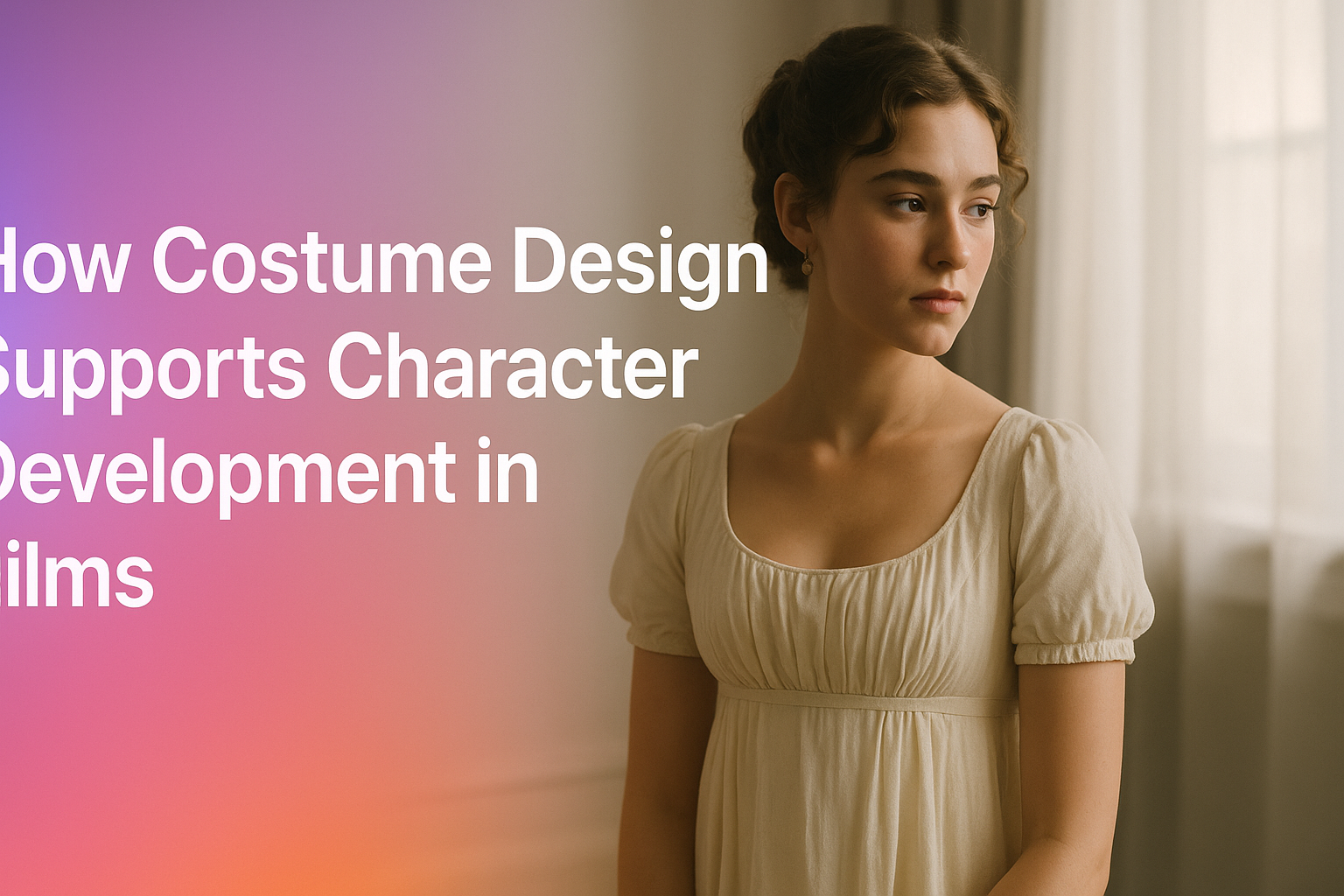
When a single costume change can reveal more about a character than a page of dialogue, you’re seeing design drive development—not just style. Costume choices aren’t decoration; they’re narrative tools that shape how audiences perceive, understand, and remember film characters.
TL;DR
- Costume design is a core storytelling device, not just visual flair.
- Effective costumes signal character arc, status, and psychology instantly.
- Modern AI tools optimise costume workflows, but creative direction remains essential.
- Industry examples show how wardrobe choices shape iconic film characters.
Costume Design: The Visual Language of Character
Costume design and character development are inseparable in professional filmmaking. A character’s clothing communicates social status, era, occupation, personality, and even inner conflict—often before a single word is spoken. According to the Academy Awards, best costume nominees consistently drive character empathy and narrative clarity, not just period accuracy. Costumes are a director’s shorthand for audience psychology.
How Costumes Signal Character Arc and Transformation
Character arcs are visual as much as verbal. Costume designers use colour, silhouette, and fabric to track a protagonist’s journey. Consider Joaquin Phoenix’s Joker: his transformation from drab, muted tones to bold, clownish colours signals psychological unraveling—a shift amplified by clothing, not just script. Vogue’s coverage of “Joker” notes how each wardrobe change cues the audience to Arthur’s evolving mindset and social status.
Iconic Examples: When Wardrobe Defines a Character
Some film costumes are so effective they become inseparable from the character’s identity. Indiana Jones’s battered fedora and leather jacket, or Amélie’s bright red cardigans, are not random style choices—they visually encode profession, temperament, and narrative intent. The Met’s Costume Institute curates film costumes as artefacts of cultural storytelling, underscoring their narrative weight.
| Film Character | Signature Costume Element | Developmental Signal |
|---|---|---|
| Indiana Jones | Fedora, leather jacket | Rugged, resourceful archaeologist |
| Amélie Poulain | Red cardigans, whimsical dresses | Innocence, optimism, Parisian charm |
| Joker (Arthur Fleck) | Clown suit, evolving palette | Descent into madness, social alienation |
| Black Panther (T’Challa) | Wakandan royal garb | Heritage, leadership, technological prowess |
| Forrest Gump | Simple, functional attire | Everyman, humility, era transitions |
Costume Collaboration: Director, Designer, and Actor
Effective costume design and character development are the result of close collaboration. Directors articulate narrative needs; designers translate those into fabric and silhouette; actors inhabit the persona through wardrobe. This three-way dialogue ensures costuming is never an afterthought. The Hollywood Reporter regularly highlights how early costume tests shape both performance and final script direction.
AI and Digital Tools: Accelerating the Costume Workflow
AI is quietly transforming costume design pipelines. Generative tools like Runway and Google DeepMind’s generative models can visualise dozens of wardrobe variations in hours, not weeks. Designers can now iterate colourways, simulate fabric drape, and test era-accuracy at scale—cutting costs and timelines. But the creative brief is still human: AI augments, not replaces, the designer-director vision.
For more on how AI is reshaping production beyond wardrobe, see our AI Video Production Complete Guide.
Costume Budgeting: Real Costs, Real Impact
Wardrobe budgets span from ₹2 lakh for indie shorts to ₹1 crore+ for major features. But effective costume design doesn’t always scale with spend—smart choices, not expensive ones, create memorable characters. Industry estimates suggest that allocating 5–10% of the total art department budget to costumes yields a strong ROI in audience recall and critical reviews. Statista data shows that films with distinctive costume palettes outperform at awards and in merchandising.
Integrating Costume Design in the Pre-Production Pipeline
Costume decisions made during script breakdown and storyboarding set the tone for the entire production. Digital moodboards, 3D previews, and AI-assisted sketching allow teams to align on character looks before a single metre of fabric is cut. This integration reduces costly reshoots and ensures visual continuity across scenes and sequels. For a deep dive on pre-production tools, see How Video Storyboards Improve the Marketing Production Process.
Ready to Elevate Your Character Design?
Our AI-enhanced movie production pipeline brings costume, set, and visual effects into one seamless workflow—at a fraction of traditional studio costs. See how Vidxen helps producers turn wardrobe choices into story-defining moments.
Costume Design vs. Production Design: Drawing the Line
While both costume and production design shape the visual world, their roles diverge. Production design handles sets, props, and locations; costume design focuses on the body and its immediate story. Overlap is inevitable—think superhero suits that blend costume with set-piece tech—but clarity on roles prevents budget bloat and creative friction. WIRED’s feature on “Black Panther” explores this intersection with real production examples.
For a look at how set elements complement wardrobe, read The Role of Production Design in Building Movie Worlds.
From Script to Screen: The End-to-End Impact of Costume Choices
Costume design and character development are iterative—refined from script notes to final edit. Wardrobe choices influence camera blocking, actor movement, and even dialogue delivery. In post, digital touch-ups or AI-based continuity checks ensure that what’s worn on screen matches the intended narrative beat, scene by scene. This is especially critical for OTT and digital-first releases, where visual clarity is non-negotiable. For full-spectrum production support, see our Movie Production service.
For more on how colour grading further shapes character perception, see How Color Grading Creates a Film’s Visual Mood.
FAQ — Costume Design & Character Development in Films
How early should costume design begin in a film project?
Costume design should start during script breakdown and storyboarding, before principal photography. Early involvement ensures visual continuity, supports budget planning, and helps actors and directors lock in character arcs from the outset. Waiting until the shoot risks rushed decisions and costly reshoots.
Can AI fully automate costume design for films?
No. AI tools like generative sketching and fabric simulation accelerate iteration, but creative intent, cultural nuance, and character psychology require human designers. The best results come from AI-augmented workflows, not automation. Human oversight is essential for narrative alignment and on-set practicality.
What’s the typical budget allocation for costume design?
Industry norms suggest allocating 5–10% of the art department budget to costumes. For indie films, this could be ₹2–8 lakh; for features, ₹25 lakh–₹1 crore+. Smart design choices often yield more audience impact than sheer spend, especially for character-driven stories.
How do costumes influence an actor’s performance?
Wardrobe choices affect posture, movement, and even vocal delivery. Actors often report that stepping into costume helps them “find” the character. Costumes also inform blocking and on-screen chemistry, shaping the final performance far beyond aesthetics.
What’s the difference between costume and production design?
Costume design focuses on what characters wear; production design handles sets, props, and the film’s physical world. Both disciplines collaborate closely, but their responsibilities and budgets are distinct. Overlap is managed through early planning and clear creative briefs.
How does costume design adapt to digital/OTT-first productions?
OTT and digital-first releases demand crisp, high-contrast costumes that read well on small screens. Designers may favour bold palettes and simplified silhouettes. AI-driven continuity tools also help maintain visual consistency across non-linear shooting schedules typical of streaming projects.
Are there best practices for integrating costume design with VFX?
Yes. Early collaboration between costume and VFX teams is crucial—especially for motion capture, chroma key, or CGI-heavy scenes. Materials, colours, and fit must be chosen to avoid post-production artefacts. Digital previews and AI simulations help future-proof designs for seamless VFX integration.
Where can I learn more about end-to-end movie production pipelines?
Explore our Movie Production service for AI-enhanced pipelines, or read the AI Video Production Complete Guide for a technical breakdown of modern workflows from scripting to final cut.