
On a typical Indian TV serial, a single living room set is shot over 250+ days—sometimes for years—with zero downtime. This relentless pace isn’t luck: it’s engineered into every inch of TV serial set design, from modular walls to AI-driven continuity checks.
TL;DR
- TV serial sets are built for speed: 2–3x faster resets, modular layouts, and durable finishes support relentless shooting schedules.
- Continuity is enforced by both human script supervisors and AI-driven tools, ensuring episodes stay visually consistent—even with overlapping storylines.
- Efficient set design directly cuts costs, reduces downtime, and enables large-scale, multi-episode production for TV and OTT.
- Modern studios increasingly use digital set extensions and virtual production to expand physical spaces cost-effectively.
Why TV Serial Sets Aren’t Like Film Sets
Film sets are built to serve a single story arc, often torn down after a few weeks. By contrast, a typical TV serial set is expected to last years—sometimes 1,000+ episodes—while supporting daily script changes, overlapping scenes, and cast rotations. In India, a prime-time drama may shoot 18–25 minutes of finished content every day, compared to a feature film’s 2–4 minutes. This relentless pace means set design must optimise for speed, repeatability, and minimal wear.
The economic difference is stark. A permanent serial set might cost ₹18–35 lakh upfront, but will amortise across hundreds of episodes—a fraction of the per-minute cost for film. For a deep dive into how these production models differ, see AI Video Production: The Complete Guide.
The pressure isn’t just on the art department. Network schedules, advertiser slots, and OTT delivery windows all demand a level of set reliability that feature films rarely require. Variety reports that India’s top soaps often shoot 300+ episodes per year—an industrial scale that drives every design decision.
Core Principles: Modularity, Durability, and Speed
Serial set design is a science of repetition. Every wall, window, and door is engineered for rapid reset and reconfiguration. Key principles include:
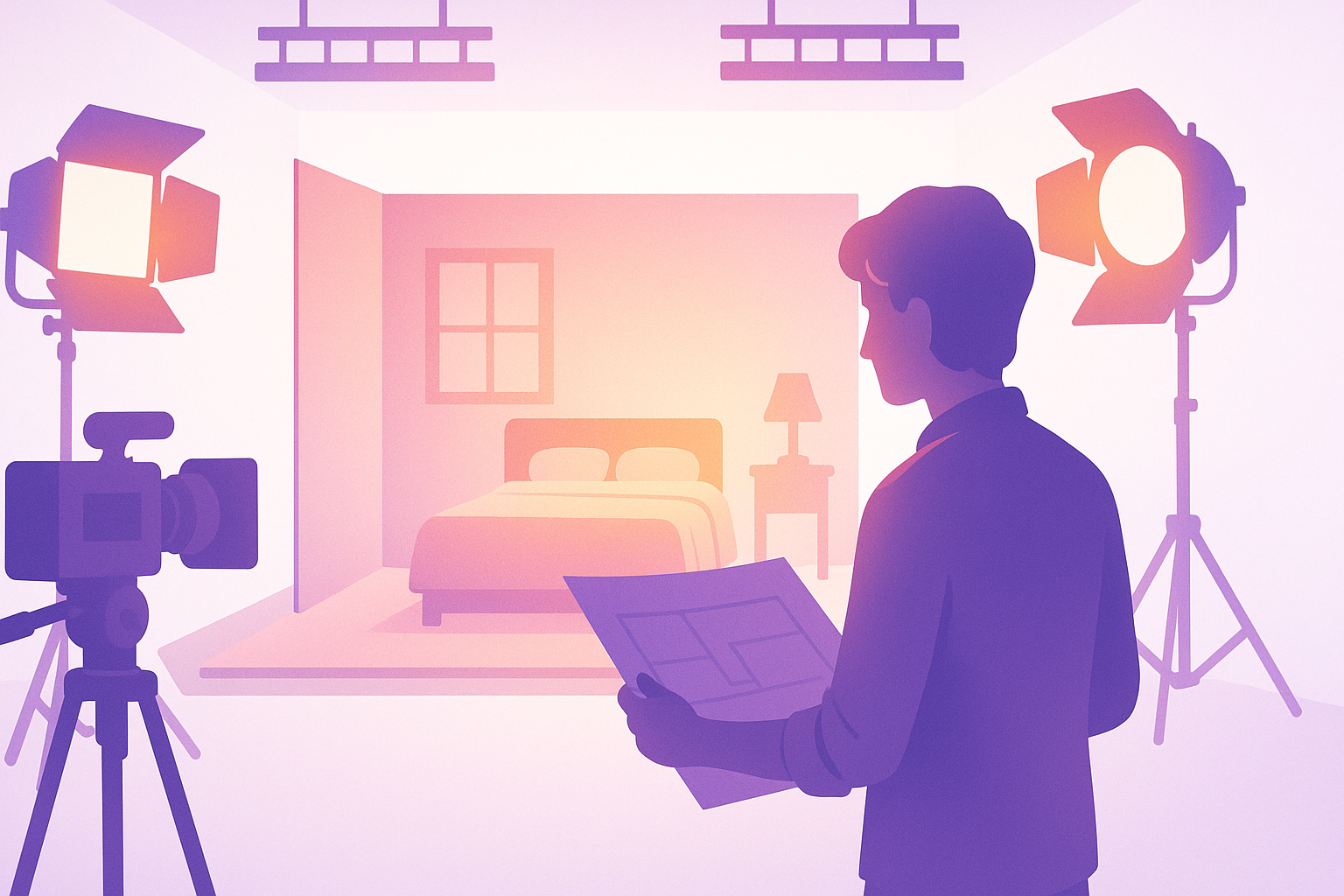
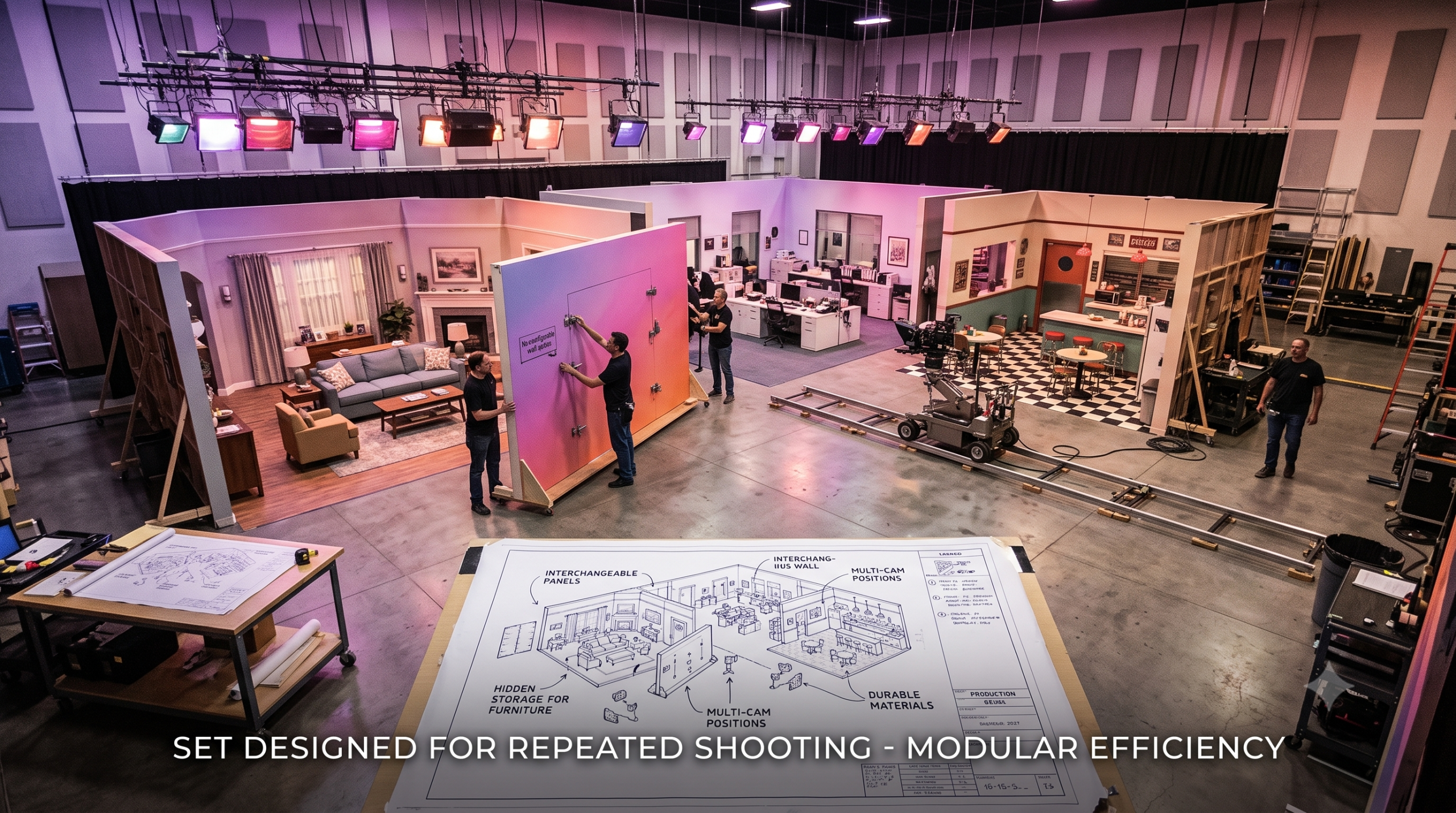
- Modularity: Sets are built in interlocking panels, so rooms can be resized or redecorated in hours—not days. Need a Diwali special? Swap wall art and drapes, not the whole set.
- Durability: Surfaces are finished with hard-wearing laminates and paints that survive hundreds of lighting resets, prop moves, and daily cleaning.
- Speed: Lighting grids, pre-rigged camera tracks, and accessible cable runs mean a crew can move from “cut” to “ready” in under 10 minutes, even for complex scenes.
Compare this to the average film set, where resets may take hours and fragile set dressing is replaced every few days. Serial sets are built to be lived in—by both characters and crew.
Continuity: The Real Test of Serial Set Design
Nothing breaks the spell of a long-running serial like a misplaced prop or a mysteriously vanishing door. Continuity is non-negotiable. On a 200-episode drama, keeping the living room sofa and family photo wall identical from week to week is a logistical nightmare—unless the set is designed for it.
- Script supervisors document every set element, from curtains to coffee tables, with high-res photos and detailed charts.
- AI-powered tools—like those built on Runway’s image comparison models—now catch discrepancies automatically, flagging mismatches before they reach the edit bay.
- Set storage is built in: spare props and doubles for high-touch items (e.g., vases, cushions) are kept on-site for instant replacement.
This is why major studios are investing in AI tools for continuity. The Hollywood Reporter notes that automated continuity checks are now standard for multi-episode productions on both sides of the Pacific.
For a focused look at how continuity impacts long-form TV, see The Importance of Continuity in Long-Running TV Serials.
Multi-Camera, Multi-Episode: Set Design for Shooting Efficiency
Serials rarely shoot in sequence. Scenes from three episodes might be filmed back-to-back on the same set in a single day, using a multi-camera setup. Sets must accommodate:
- Hidden rigging: Lighting grids and track mounts are integrated above ceilings and behind walls, invisible to camera but accessible for crew.
- Flexible blocking: Open-plan layouts allow directors to stage multiple scenes (dining, living, foyer) without moving walls.
- Sound isolation: Double-thick flats and acoustic panels reduce noise bleed, crucial when up to four units shoot simultaneously on adjacent sets.
This architecture isn’t just about convenience—it’s about survival. With network delivery deadlines measured in hours, not days, every minute lost to a set reset is money burned. According to Statista, every hour of Indian TV drama costs ₹10–18 lakh to produce; fast, reliable sets are the only way to keep per-episode costs viable.
For more on the director’s perspective in these environments, see How Television Directors Manage Multi-Camera Productions.
Episodic Scale: How Set Design Reduces Cost and Downtime
TV serial set design isn’t just about aesthetics. It’s a cost-control lever. The more efficiently a set can be reused, the lower the per-episode spend. Key tactics:
- Reversible flats: Walls are painted differently on each side, so a “new” room is a quick flip away.
- Prop pools: Everything from lamps to kitchenware is standardised and catalogued, so replacements are seamless.
- Digital set extensions: Green screens and LED walls allow virtual balconies, cityscapes, or even entire exteriors to be swapped in post, reducing the need for expensive location builds.
This shift towards hybrid sets is accelerating. Adobe reports that virtual production workflows are now standard in episodic streaming, letting producers stretch budgets without sacrificing scale. Indian OTT serials are rapidly following suit, blending physical and digital assets for maximum flexibility.
Scale Your Serial—Without the Chaos
Get AI-assisted set design and post-production pipelines built for multi-episode TV, web series, and OTT. Consistency, speed, and cost-control for every shoot. Brief us your project and see what’s possible.
Digital Tools: AI Pipelines and Virtual Set Management
AI is quietly transforming set management. Tools like Google DeepMind’s scene recognition models and OpenAI’s generative visual tools are now used to automate everything from continuity tracking to virtual set dressing. On a daily basis, these systems:
- Scan each frame for out-of-place props or set damage, alerting crew before a reshoot is needed.
- Generate digital set extensions so producers can “build” new rooms or exteriors in post, not on the lot.
- Automate script-to-set mapping, helping art departments prep for complex, multi-episode shoots with minimal error.
Studios adopting these AI pipelines are seeing 20–35% reductions in set-related reshoots and up to 60% faster turnaround on episodic post. This level of automation is now a baseline for network-ready, scalable serials. For an overview of how these pipelines impact the entire production process, see TV Serials & Series.
Case Study: A Day on a Serial Set
Let’s break down a real shooting day for a Hindi prime-time serial:
| Time | Activity | Set Design Impact |
|---|---|---|
| 7:00–9:30 AM | Lighting and camera pre-rig, prop checks | Pre-installed rigs, modular props speed setup |
| 9:30–1:00 PM | Shoot living room scenes for 3 episodes | Open-plan set, fast resets, built-in continuity |
| 1:00–2:00 PM | Lunch + minor set redressing | Swap wall art, minor prop changes in 15 minutes |
| 2:00–6:00 PM | Simultaneous kitchen + bedroom scenes | Sound isolation, parallel crew access |
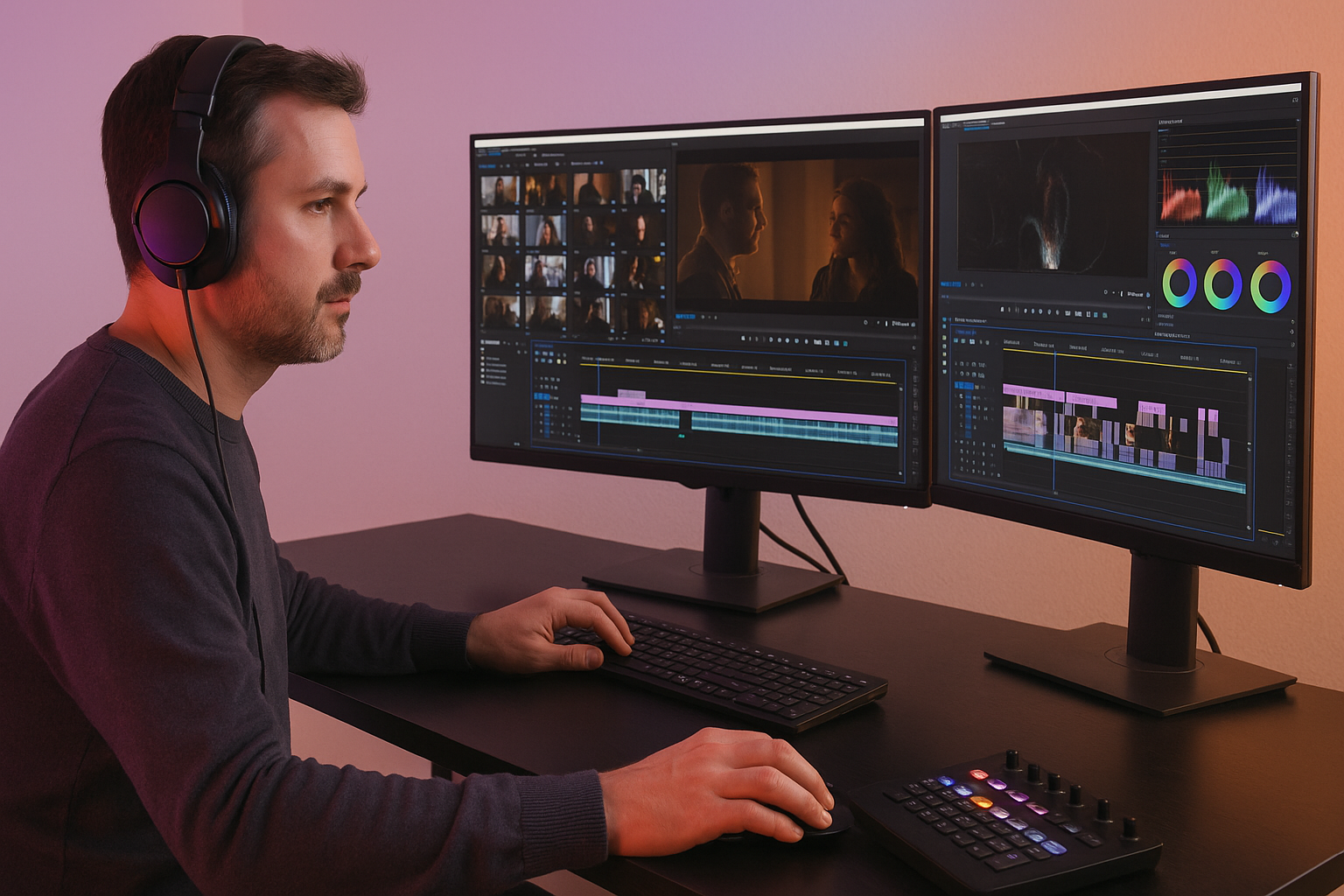
| 6:00–7:00 PM | AI continuity check, set reset for next day | Automated tools flag issues before wrap |
Multiply this routine by 250+ days per year—every efficiency compounds. Studios that fail to design for this grind simply can’t compete in today’s OTT and network markets.
Set Design for Streaming vs. Traditional TV
Streaming originals (Netflix, Amazon, Hotstar) demand even more from set design:
- Higher resolution: OTT platforms deliver in 4K or higher, so every set flaw is visible. Materials and finishes must stand up to scrutiny.
- Rapid scaling: Binge-release seasons mean 8–12 episodes are shot in blocks, not week-to-week. Sets must flex for mass production.
- Multi-language delivery: Sets are prepped for easy redressing to support international and regional dubs, with neutral branding and adaptable signage.
OTT buyers expect the speed of TV with the craft of film. This hybrid pressure is pushing Indian studios to adopt global best practices—modularity, digital extensions, and AI-driven quality control. The Hollywood Reporter details how streaming has upended set economics worldwide.
For strategies to repurpose episodic content across platforms, see How Brands Can Repurpose One Video Across Multiple Social Platforms.
Conclusion: The Future of TV Serial Set Design
The days of static, fragile TV sets are over. Today’s serial set design is a blend of engineering, digital automation, and relentless pragmatism—built for scale, speed, and visual consistency. As AI pipelines advance, expect even tighter integration between script, set, and screen. The winners will be those who design for the grind, not just the premiere.
For in-depth guidance on AI-driven production and set workflows, see our pillar: AI Video Production: The Complete Guide.
To discuss scalable, network-ready set solutions for your serial or series, talk to our TV Serials & Series team.
FAQ — TV Serial Set Design for Repeated Shooting
How do TV serial sets differ from film sets?
TV serial sets are designed for longevity and speed. They use modular, durable materials and layouts that support daily resets and multi-episode shooting. Film sets, by contrast, are often built for one-off scenes and may prioritise visual detail over long-term usability. TV sets must also support rapid redecorating for new storylines and high shooting volumes.
What is the role of AI in modern set design?
AI now automates continuity checks, flags misplaced props, and enables virtual set extensions. Systems built on platforms like Runway and Google DeepMind help studios maintain consistency across episodes, reduce reshoots, and even generate new set elements digitally, saving both time and money.
How do studios ensure set continuity over hundreds of episodes?
Studios combine detailed manual documentation (photos, charts) with AI-powered image comparison tools to track every prop and decor item. Spare props and duplicates are kept on hand. Some studios use custom-built software to log changes and automate alerts when discrepancies are detected, ensuring seamless visual continuity for the viewer.
Why is modularity crucial in TV serial set design?
Modularity allows sets to be quickly reconfigured or redecorated for different scenes or episodes. This flexibility supports fast shooting schedules and enables the same physical space to represent multiple locations. Modular sets also reduce downtime and allow for creative adjustments as scripts evolve—vital for long-running serials.
What are digital set extensions and how are they used?
Digital set extensions use green screens, LED walls, or post-production VFX to add virtual elements—like city views or new rooms—without physically building them. This approach, widely covered by Adobe, lets producers scale up visual scope while controlling costs and shoot schedules.
How does set design impact production costs?
Efficient set design reduces the need for frequent rebuilds, lowers the risk of costly reshoots, and allows for parallel shooting—all of which drive down per-episode costs. Modular, durable sets are a direct cost-saving investment, especially for serials running hundreds of episodes or more.
Are there special requirements for streaming/OTT series?
Yes. OTT platforms require higher resolution sets, rapid scaling for batch shooting, and adaptability for multi-language releases. Sets must be camera-ready for 4K+ capture and designed to allow easy redressing and branding changes. These demands have accelerated the adoption of digital and AI-driven set workflows in India and globally.
Where can I get help designing scalable sets for my serial?
Solutions for scalable, AI-integrated set design are available from specialists like our TV Serials & Series team. We provide end-to-end support for episodic set workflows, from modular builds to digital extensions and post-production pipelines. Book a call to discuss your show’s requirements and production targets.