
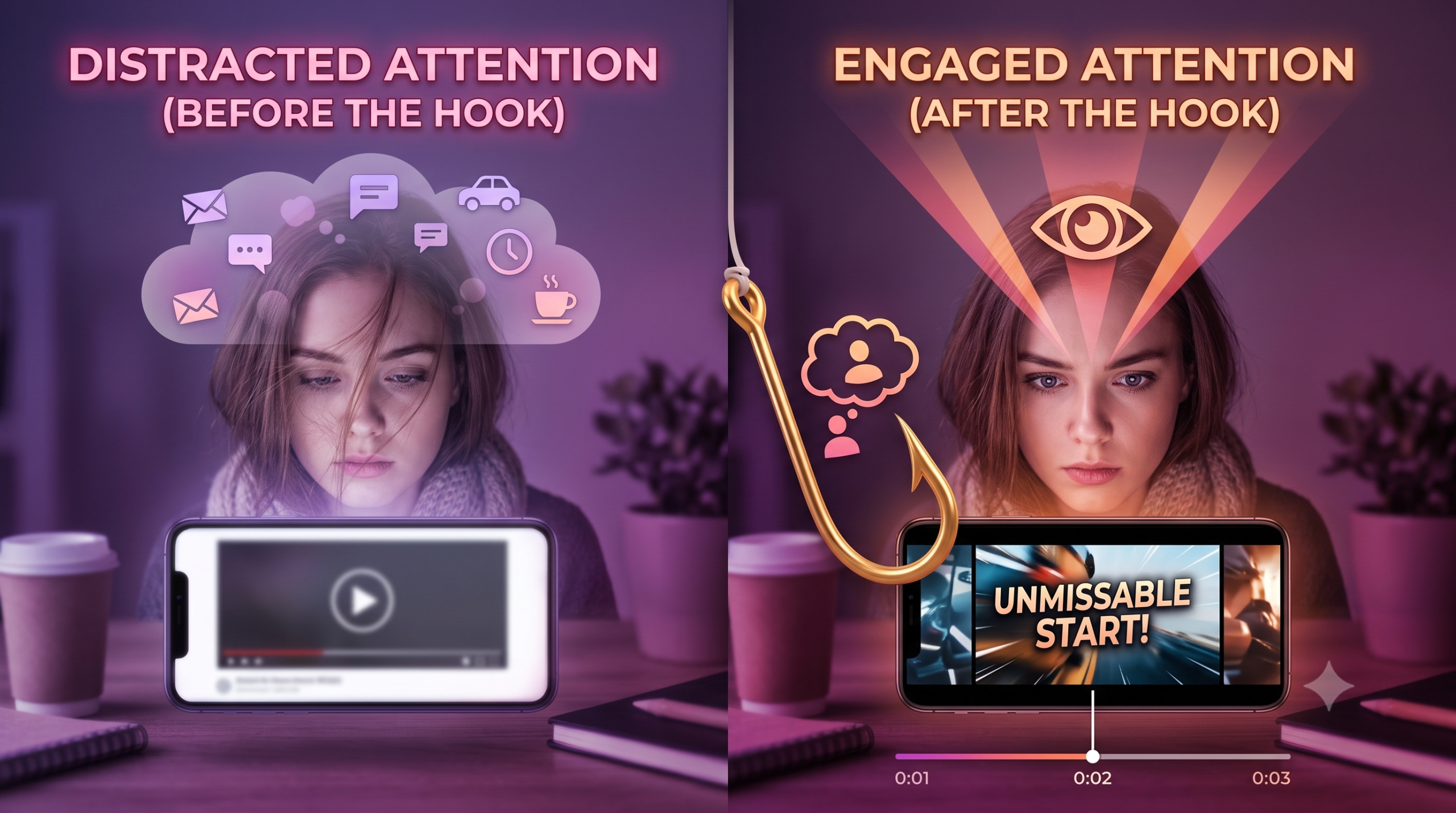
On average, 47% of viewers decide to keep watching or scroll away within the first 3 seconds of a video ad. The difference between a “hook” that lands and one that flops is measurable in engagement rates, conversion, and ad spend efficiency. Let’s break down what actually holds attention—and what’s just industry noise.
TL;DR
- The opening 3–5 seconds of a video determine up to 70% of total engagement and retention.
- Effective hooks use pattern disruption, direct address, and relevance—AI tools can optimise but not replace creative judgement.
- Data-driven hooks outperform generic intros by up to 2.3× in marketing videos.
- Testing and analytics, not guesswork, drive continuous improvement and ROI.
Why Hooks Matter: The Real Cost of Losing Attention Early
If your video’s first five seconds don’t stop the scroll, you’ve lost both the viewer and your ad budget. According to Think with Google, ads with strong hooks in the first moments see up to a 33% lift in brand recall and a 23% boost in purchase intent. That’s not theory—it’s direct impact on campaign ROI. For a typical ₹50,000 video ad spend, a weak hook can waste half your impressions. In short: hooks aren’t creative fluff, they’re the front line of your conversion funnel.
The Psychology of Attention: What Actually Makes a Hook Work?
Attention isn’t just a function of loud visuals or fast editing. Neuroscience research from Nature Scientific Reports shows that humans are wired to notice novelty, emotional cues, and direct address. That’s why a sudden question (“Ever wasted money on video ads that flop?”), an arresting image, or a strong emotional statement works better than generic logo reveals. The best hooks combine pattern disruption with immediate relevance—something AI tools like Runway can help generate, but only when guided by sharp creative direction.
Scroll-Stopping Hooks: Anatomy and Examples
Scroll-stopping hooks are engineered, not improvised. High-performing marketing videos use:
- Pattern Disruption: Unexpected visuals or statements that jar viewers out of autopilot (e.g., “Stop wasting ₹5,000 a day on ads no one remembers.”)
- Direct Address: Speaking to the viewer by calling out their pain point or aspiration (“This is for SaaS founders who need demo videos that convert.”)
- Visual Intrigue: Unusual imagery, movement, or transitions that demand a second look (animated graphs, AI-morphed faces, etc.)
- Micro-storytelling: Teasing a narrative in one line (“Three months ago, we had zero customers. Here’s what changed.”)
For more on how narrative structure powers short-form videos, see The Role of Storytelling in Short-Form Social Media Videos.
Data-Driven Hook Frameworks: What Actually Delivers Results?
Forget the myth that “creativity can’t be measured.” Platforms like YouTube, Instagram, and TikTok provide precise analytics on viewer drop-off. According to HubSpot Research, videos with a data-driven hook framework (such as question + visual surprise) see average watch times increase by 35% compared to those with generic intros. AI-powered tools like Google DeepMind’s video generation research now enable rapid A/B testing of hooks—optimising for retention, not just views.
Proven frameworks include:
- The “Problem-Agitate-Solve” opener (“Struggling to get leads? Here’s why your videos aren’t converting.”)
- “Before/After” visual split (showing a dull vs. vibrant outcome in 2 seconds)
- Rapid-fire stat + question (“82% of buyers watch product videos before purchasing. Are yours working?”)
For a deeper dive into emotional impact, see Why Emotional Storytelling Works in Marketing Videos.
AI Tools and Human Direction: The Real Story Behind Modern Hooks
AI can generate hundreds of hook variations in minutes—but only human judgement knows which one fits your brand’s tone and your audience’s psychology. For example, OpenAI’s Sora or Runway’s Gen-2 can create compelling footage, but the creative decision on what to show first still sits with your team. The winning formula is AI-powered ideation, filtered through data (A/B testing), and finalised by human creative direction. This is how you get both speed and substance.
Testing, Analytics, and Iteration: Closing the Loop
Every hook is a hypothesis. The only way to know what works for your brand is to test, measure, and iterate. Successful marketing teams use platform analytics (watch time, retention curves, click-through) to refine hooks over multiple campaigns. As Statista reports, brands that systematically test hooks see up to a 2× increase in ROI and significant drops in cost per acquisition. If your agency isn’t running hook experiments, you’re leaving money on the table.
Ready to Stop the Scroll?
Brief us your project and get a scroll-stopping marketing video with hooks designed for your audience. We pair AI-powered production with creative direction for measurable results.
Common Pitfalls: Hooks That Fail (and Why)
Not all hooks are created equal. The most common failures include:
- Generic intros: “Welcome to our video”—instantly ignored.
- Irrelevant visuals: Stock footage that doesn’t connect with the audience’s problem.
- Overly salesy tone: Pitches before value—viewers tune out.
- Slow pacing: No clear payoff in the first three seconds.
- Unclear messaging: The viewer doesn’t know who it’s for or why it matters.
Our experience across 500+ projects shows that eliminating these pitfalls boosts retention curves and improves campaign efficiency without raising production costs.
Practical Guide: Building Hooks that Hold Attention
Here’s a practical workflow for crafting effective video hooks for viewer attention:
| Step | Action | Why it Works |
|---|---|---|
| 1. Define your audience | Clarify pain points and aspirations | Ensures relevance from frame one |
| 2. Brainstorm hook angles | Use AI tools for rapid ideation | Generates volume and variety |
| 3. Script multiple hook options | Write 3–5 short, punchy openers | Allows for A/B testing |
| 4. Produce rapid prototypes | Edit quick variations using AI-powered platforms | Speeds up iteration |
| 5. Test and measure | Deploy on target platforms, review retention data | Refines hook based on real behaviour |
| 6. Iterate and finalise | Double down on what works, discard what doesn’t | Continuously improves ROI |
For a complete overview of AI-powered video production workflows, see our AI Video Production Complete Guide.
Want to see how casting and on-screen talent influence first impressions? Read How Casting Decisions Influence a Movie’s Success.
To see how marketing video hooks are integrated into high-converting content, explore our Marketing Videos service page.
Case Study: Hook Optimisation in Real Campaigns
A SaaS client launching a new platform saw a 62% increase in 10-second retention after switching from a logo intro to a “problem-agitate-solve” hook. By using AI to generate three variations and testing each, the best-performing version delivered a 2.1× lift in click-through rate. Similar results are echoed in Wistia’s video marketing benchmarks, where high-retention hooks correlate directly with conversion and lower CPA.
Summary: What to Do Next
Hooks aren’t a creative luxury—they’re a measurable lever for video marketing ROI. The difference between a forgettable intro and a scroll-stopper is grounded in data, psychology, and disciplined iteration. Whether you’re producing in-house or working with an agency, make hook testing a non-negotiable part of your process. You’ll see the results in your retention curves—and your bottom line.
FAQ — Video Hooks for Viewer Attention
What is a video hook and why does it matter?
A video hook is the opening 3–5 seconds designed to capture attention and signal relevance. It matters because most viewers decide within these seconds whether to keep watching or scroll away. Strong hooks improve engagement, retention, and conversion rates, making them critical for marketing video success.
How do you measure if a hook is working?
You measure hook effectiveness by analysing watch time, retention curves, and drop-off rates in your platform analytics. If a high percentage of viewers stay past the first five seconds, your hook is working. A/B testing multiple hooks and comparing their performance is the most reliable approach.
Can AI tools create effective hooks on their own?
AI tools can generate a range of hook ideas and visual assets quickly, but they don’t understand audience psychology or brand tone. The best results come from combining AI-powered ideation with human creative direction and data-driven testing to select the most effective hook for your campaign.
What are some proven hook frameworks for marketing videos?
Top frameworks include “problem-agitate-solve” (addressing a pain point and offering a solution), “before/after” visual splits, direct questions, and rapid-fire stats. These structures disrupt patterns and make the viewer immediately aware of the video’s relevance to them, driving higher retention.
Should every marketing video have a different hook?
Not every video needs a unique hook, but tailoring hooks to audience, platform, and campaign objectives is essential. Testing variations helps identify which hooks resonate best. Repeating the same intro across campaigns can lead to “banner blindness” and lower engagement over time.
What common mistakes should I avoid when creating hooks?
Avoid generic greetings, irrelevant visuals, slow pacing, and sales pitches before delivering value. Hooks should be direct, relevant, and visually engaging. Failing to clarify the audience or problem leads to high drop-off and wasted ad spend.
How can I integrate effective hooks into my marketing video strategy?
Start by scripting multiple hook variations, use AI tools for rapid ideation, and test each version on your target platforms. Analyse retention and engagement metrics, then iterate based on real data. Make hook optimisation a core part of your video content workflow.
Where can I get help producing videos with high-performing hooks?
If you need scroll-stopping hooks and data-driven video production, explore our Marketing Videos service. We combine AI-powered tools with experienced creative direction to deliver high-converting content for every platform.