
Coordinating a ₹100 crore feature film is less about red carpets and more about 500+ moving parts—budgets, teams, VFX, and technology pipelines. The real work of film producers? Delivering cinematic quality at scale, often saving millions and months by rethinking every production step.
TL;DR
- Film producer responsibilities go far beyond hiring and fundraising—they run the entire production pipeline.
- AI, cloud, and remote tools are slashing VFX costs by up to 80% and accelerating timelines 2–4×.
- Risk mitigation, creative control, and team orchestration are core to blockbuster success.
- End-to-end production, from script to streaming, now demands tech fluency and ruthless cost control.
What Does a Film Producer Actually Do?
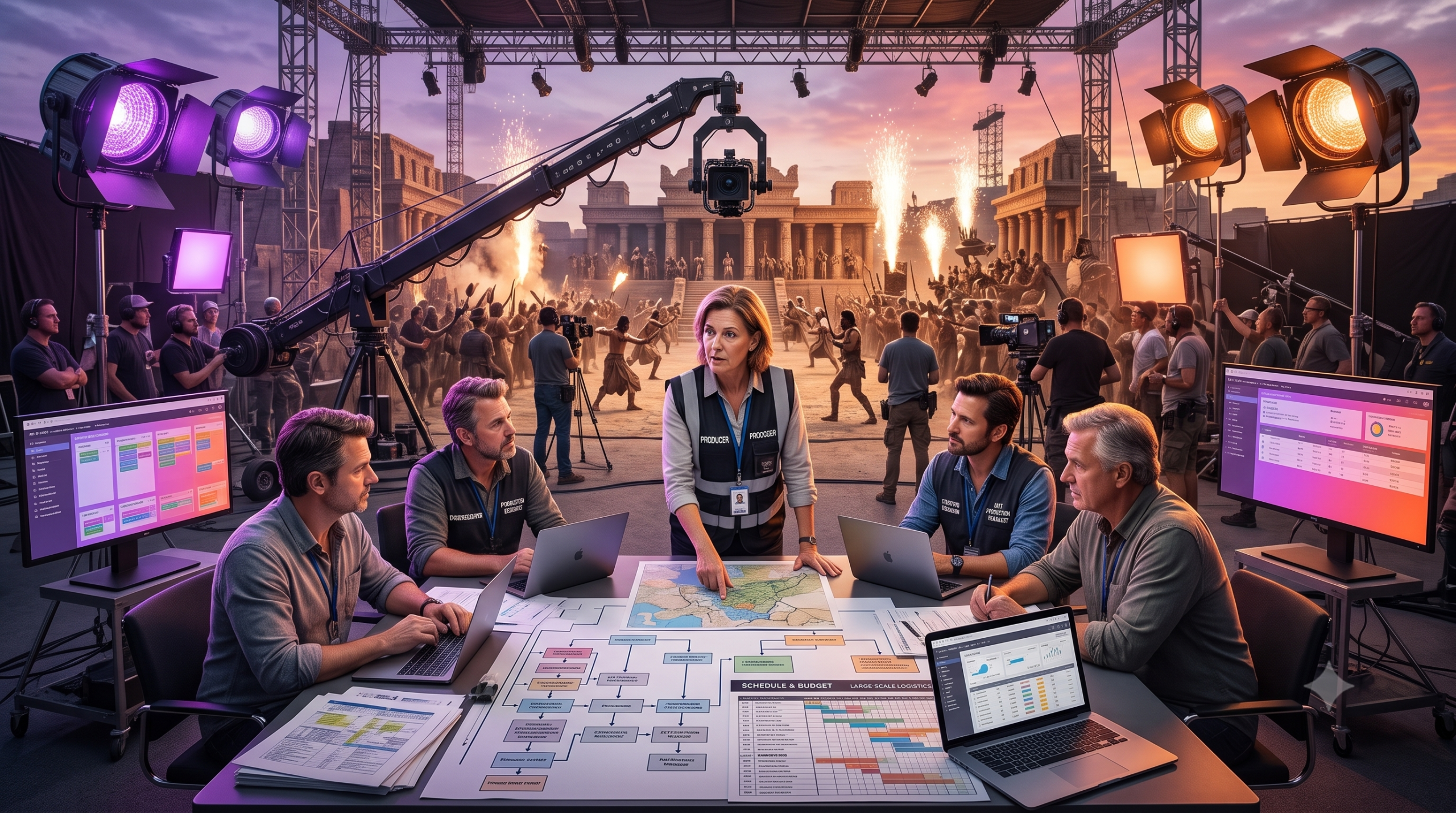
Forget the Hollywood stereotype: the real film producer responsibilities start months before a single frame is shot. Producers acquire rights, lock in financing, hire the creative team, and wrangle schedules. On large-scale films—think ₹100 crore budgets and 300+ crew—they oversee every department: script, casting, location, VFX, and post-production. Their main deliverable? A completed film, on time, on budget, and at the promised quality.
It’s a job where a missed location permit or a delayed VFX handoff can cost ₹5 lakh a day. The producer is the ultimate project manager, creative arbitrator, and risk-mitigator in one.
| Responsibility | Typical Task | Impact on Production |
|---|---|---|
| Financing | Securing studio/investor funds | Keeps production moving |
| Scheduling | Coordinating shoot days, VFX reviews | Prevents costly overruns |
| Team Management | Hiring director, HODs, cast | Defines creative/technical standards |
| Creative Oversight | Script approvals, edit reviews | Ensures vision meets market |
| Risk Management | Insurance, legal, contingency planning | Protects investment |
| Distribution | Negotiating with OTT, theatrical, festivals | Maximises audience reach |
For a detailed breakdown of production roles, see The Role of a Film Director From Script to Final Cut.
Managing Budgets: Why Producers Sweat Every Rupee
On a ₹100 crore film, a 2% overrun means ₹2 crore lost—often enough to sink a project’s ROI. Producers build granular budgets, negotiate every vendor contract, and monitor daily burn rates. VFX, traditionally a budget black hole, is now streamlined with AI tools, cloud rendering, and remote-first teams. Hollywood studios have reported up to 60% savings by shifting to hybrid AI-human pipelines.
Producers also leverage tax incentives, co-productions, and pre-sales to de-risk finances. Every major decision—casting, location, set build—is weighed against both creative value and cost impact.
Orchestrating Teams: Communication at Scale
On a Marvel-scale shoot, the producer’s “team” runs into the hundreds: actors, stunt coordinators, VFX supervisors, line producers, editors, and more. The producer sets up communication structures—daily standups, dailies reviews, cloud-based asset management (think Adobe Frame.io or DaVinci Resolve collaborative workflows)—to keep everyone aligned.
Conflicts are inevitable. The producer acts as arbiter between creative (director, DOP) and logistical (line producer, finance). When a star’s schedule changes or a VFX vendor misses a milestone, the producer’s crisis management skills are tested in real time.
Tech Stack: From AI Pipelines to Real-Time VFX
Today’s film producer needs more than a spreadsheet—they need to understand the tech stack powering modern productions. AI-driven VFX, generative backgrounds, cloud-based dailies, and remote sound mixing are now standard. Runway’s Gen-2 and OpenAI’s Sora enable photorealistic scene generation, cutting traditional VFX costs by up to 80% and reducing weeks of manual compositing to days. Producers must vet these tools for reliability and cost efficiency.
At Vidxen, we’ve seen clients save $2.5M+ on large-scale VFX by deploying AI pipelines for crowd simulations and background replacement. The result? Hollywood-level visuals without Hollywood-level invoices.
For a deep dive on the impact of cinematography and tech, explore How Cinematography Shapes the Visual Identity of a Film.
Risk Mitigation: Insurance, Legal, and Contingency Planning
Every large-scale film is a risk magnet: weather delays, on-set injuries, actor dropouts, data breaches. Producers secure insurance for cast, crew, and equipment, and build contingency budgets (typically 5–10% of total spend). They also manage copyright, union compliance, and data security—especially as cloud workflows expand. C2PA standards are now adopted to verify AI-generated content authenticity, protecting both IP and reputation.
Risk is never eliminated, only managed. The producer’s job is to keep the film moving, no matter what the universe throws at them.
End-to-End Production: From Script to Streaming
Modern producers don’t stop at “final cut.” Distribution is baked in from day one—OTT deals, festival strategies, and multi-language versions are planned alongside the shoot. Producers work with post-production teams for 4K upscaling, Dolby Atmos mixes, and platform-specific deliverables.
AI-driven dubbing (see ElevenLabs for synthetic voices) makes multi-language releases cost-efficient—often 1/10th the price of traditional dubbing. Producers ensure every output meets technical specs for Netflix, Amazon Prime, Disney+, and regional OTTs.
For a full rundown on how the entire pipeline fits together, see our pillar post: AI Video Production: The Complete Guide.
Ready to Ship a Blockbuster—Without the Blockbuster Headaches?
Get Hollywood-level visuals, AI-enhanced VFX, and end-to-end production support—from script to streaming. Brief us your project and see how much time and budget you can save with a modern production pipeline.
How Producers Use AI to Optimise Production
AI isn’t just a buzzword—producers are deploying it for script breakdowns, scheduling, crowd simulation, and even generative storyboarding. Tools like Google Veo and Runway automate tedious VFX, while platforms such as OpenAI Sora allow for rapid scene prototyping.
Industry estimates suggest AI-driven pipelines now cut post-production time by 50–70%. Producers who embrace these tools deliver more, faster, and with fewer budget surprises. For independent filmmakers, it levels the playing field with the majors.
For practical strategies on integrating AI into your workflow, check out our service page: Movie Production.
Case Study: $2.5M Saved on VFX for a Feature Film
One Vidxen client—a major studio—needed 200+ VFX-heavy shots for a historical drama. Traditional bids came in at $3M and a 10-month timeline. By deploying AI for background replacement, crowd simulation, and automated rotoscoping, the final cost dropped to $500K and delivered in under 4 months. The film hit OTT and theatrical release on schedule, with audience reviews praising its cinematic quality.
This isn’t isolated—major productions worldwide are seeing similar results. Statista confirms that AI and digital-first pipelines are the key drivers of cost reductions in global film production.
For more on how writing and showrunning fit into the big-picture, see The Role of a Showrunner in Modern TV Series Production.
Common Pitfalls: Where Large-Scale Productions Fail
It’s not just budget overruns—films stall because of poor communication, unclear creative vision, or tech bottlenecks. Producers who neglect cloud-based dailies, fail to vet AI tools, or ignore data security can face catastrophic delays. Even with AI, human oversight is non-negotiable: a mismanaged VFX pipeline or a missed legal clearance can cost weeks and crores.
The most successful producers combine ruthless attention to detail with a willingness to adapt—balancing legacy filmmaking instincts with next-gen technology.
To understand the broader context of pre-production and post-production, read Pre-Production vs Production vs Post-Production: Understanding the Filmmaking Process.
FAQ — Film Producer Responsibilities & Large-Scale Movie Production
What are the core responsibilities of a film producer on a large-scale movie?
A film producer oversees financing, scheduling, hiring, creative approvals, risk management, legal compliance, and final delivery. On big-budget films, they coordinate hundreds of crew, manage multi-crore budgets, and ensure the finished film hits both quality and distribution targets. Their job is to deliver a market-ready product on time and within budget.
How are AI tools changing film producer responsibilities?
AI pipelines streamline VFX, automate scheduling, and enable rapid script breakdowns, letting producers cut costs and timelines by up to 70%. Producers now need to vet, deploy, and manage these tools, balancing technological fluency with classic production oversight. AI is an accelerator—not a replacement for creative or managerial judgement.
What’s the most common cause of large-scale film production delays?
Communication breakdowns, missed clearances, and tech bottlenecks are top culprits. Even with AI, lack of human oversight or poor team orchestration can stall production. Producers who establish robust communication and contingency plans are best positioned to avoid costly delays.
How much can a producer save by using AI-powered VFX?
Industry data and real-world case studies show savings of 60–80% on complex VFX sequences using AI-driven pipelines. For example, a $3M manual VFX budget can often be reduced to $500K–$1M with AI, while maintaining cinematic quality and slashing delivery times from months to weeks.
Do producers still need traditional skills in an AI-powered workflow?
Absolutely. While AI accelerates workflows, producers must still manage teams, negotiate contracts, and safeguard creative vision. Technology is a tool; the producer’s judgement, problem-solving, and communication remain irreplaceable—especially on large, complex projects.
What types of content can benefit from AI-enhanced production?
Feature films, documentaries, music videos, and even historical restoration projects now leverage AI for VFX, upscaling, and multi-language delivery. Producers can achieve Hollywood-level visuals for OTT, streaming, and theatrical releases—often with dramatically reduced budgets and timelines.
Where can I learn more or get help with AI-powered movie production?
Explore our Movie Production service for end-to-end support, or see our AI Video Production: The Complete Guide for an in-depth look at modern production pipelines. For practical case studies and strategy, browse our other articles on the blog.
How do producers ensure content is OTT and streaming ready?
Producers work with post-production teams to deliver 4K upscaling, Dolby Atmos mixes, and platform-specific formats. AI-driven dubbing and QC ensure the final product meets technical specs for Netflix, Amazon Prime, Disney+, and regional OTTs—maximising audience reach and compliance.